Sous-vide · Comparison
Research-basedAnova Precision Cooker 3.0 vs Anova Precision Cooker Pro: who actually needs the Pro
The Pro lists at roughly double the 3.0's price and Anova's own pages explain why in familiar words: more watts, more flow, a tighter decimal, built for bigger kitchens. We went looking for the point where that story becomes a fact about your cooking instead of a fact about a spec sheet.
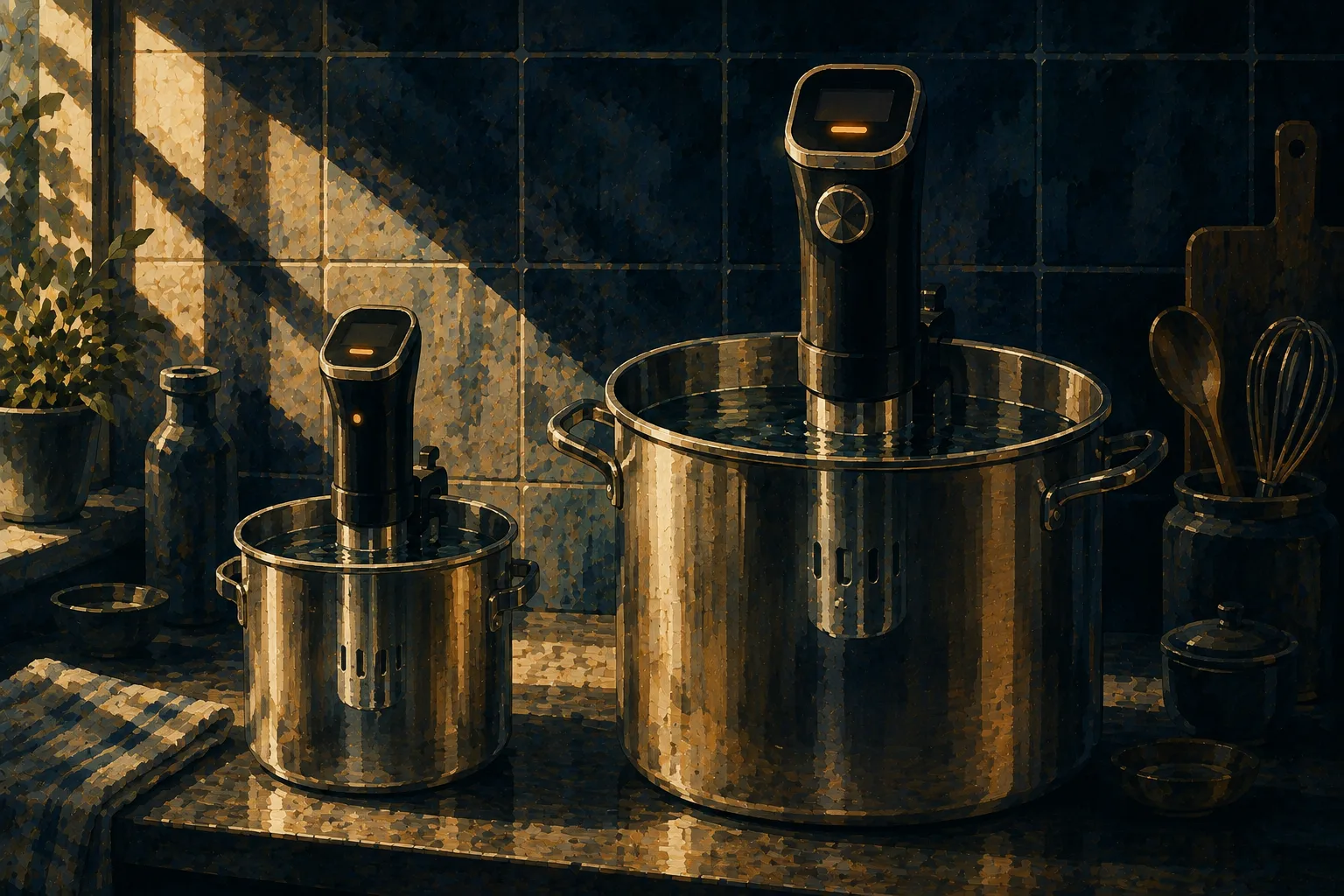
Illustration
Contents
- The short table
- Power, flow and the two numbers that don't race each other
- Accuracy: one claim has been audited, one hasn't
- The water line nobody prints, and the one number that exists
- Clamp, screen and a small reversal
- Noise, and a duty number nobody can check
- Two thin reliability records
- Warranty ties, price mostly doesn't
- What would change this
- The Pro's accuracy claim, still unaudited
- Decision
- The evidence
- Sources
The short answer
Buy the Precision Cooker 3.0 if you cook in stockpots, tubs or a single cooler at a time: it carries the class's only independently audited accuracy figure (0.06°F measured against a declared ±0.2°F claim), a wider 1.4-inch clamp, dual-band WiFi, and on 28 October 2026 it listed at about half the Pro's price. Buy the Pro if you regularly fill a vessel near its documented 26-gallon ceiling, or you run it back to back across long stretches; its higher flow rate, deeper water window and 10,000-hour motor claim exist for exactly that load, though no independent lab has audited its accuracy or heat-up time the way TechGearLab audited the 3.0. If your biggest vessel is a stockpot and your longest cook is a weekend brisket, the 3.0 already covers you and the extra watts buy headroom you won't spend.
On 28 October 2026 Anova's store listed the Pro at about twice the price of the 3.0, with no sale on either (E·02, E·04). When we first looked in August both machines carried sale prices that put them much closer, and that gap has gone. The premium for the company's own pricier Precision Cooker Pro is large, and the evidence trail doesn't grow to match: the 3.0 has been through an independent lab's instrumented test, and the Pro, as far as this research could find, has not. Anova's page for the bigger, pricier circulator answers with bigger numbers everywhere: more watts, faster flow, a tighter decimal on the accuracy line, and it is tempting to read those numbers as a verdict on which machine is built for professionals and which is built for hobbyists. Whether that story holds up turns out to hinge on one number almost nobody prints anywhere: how big your vessel actually gets.
The two machines are Anova's Precision Cooker 3.0 and Precision Cooker Pro, the company's default wand and its stated commercial-grade option, the Pro listing at about twice the 3.0's price on 28 October 2026 (E·02, E·04). We pulled both product pages, TechGearLab's instrumented lab test of the 3.0, Reviewed's separate test of the Pro, a measured-spec comparison and a hands-on review from Amazing Food Made Easy, and owner threads about both machines. One thing to flag before any of it: when the two Anova product pages agree with each other on a spec, that is one source describing itself twice, not two sources confirming a fact, and we treat it that way below.
The short table
| Attribute | Anova Precision Cooker 3.0 | Anova Precision Cooker Pro |
|---|---|---|
| Power / flow rate | 1100 W, 8 L/min (E·01) | 1200 W, 12 L/min (E·03) |
| Declared accuracy | ±0.1°C / ±0.2°F (E·01) | ±0.05°C / ±0.09°F (E·03) |
| Independent instrumented test | Yes, TechGearLab lab protocol, Editors' Choice (E·06, E·07) | None found; Reviewed's heat-up test used a different protocol (E·08, E·09) |
| Measured heat-up | 36 min, 9.5 qt cold tap water to 147°F (E·06) | 22 min to 132°F, different lab and target (E·08) |
| Water window | 65 mm minimum stated; no maximum published (E·01, E·05) | 62-170 mm, minimum to maximum (E·03) |
| Rated capacity | not published in gallons or liters (E·05) | up to 26 gallons / about 100 L, manufacturer claim (E·05) |
| Clamp | Twist-style, 1.4 in gap, measured (E·10) | Screw with slide adjust, 1.1 in max opening, measured (E·11) |
| Connectivity | Dual-band WiFi 802.11 b/g/n (E·01) | Single-band WiFi 802.11 b/g/n, 2.4 GHz (E·03) |
| Measured noise | not independently measured in this research | 57 dB adjacent, 52 dB at 12 in (E·12) |
| Motor duty claim | not published | 10,000 hours nonstop, manufacturer claim, unverified (E·13) |
| Warranty | 2 years (E·01) | 2 years (E·03) |
| Price (checked 28 October 2026) | Regular price, no sale shown; it was on sale in August (E·02) | About twice the 3.0's price, no sale shown; it was on sale in August (E·04) |
Power, flow and the two numbers that don't race each other
Anova rates the 3.0 at 1100 watts and 8 L/min of flow, and the Pro at 1200 watts and 12 L/min (E·01, E·03). Watts and liters per minute describe pump and heater capacity, not what happens in your kitchen, so the number worth trusting is measured. TechGearLab heated 9.5 quarts of 50°F tap water to 147°F in 36 minutes with the 3.0 (E·06). Reviewed heated a bath to 132°F in 22 minutes with the Pro (E·08).
Do not average those two numbers. They are not the same test. Different lab, different container, a target fifteen degrees lower, and the Pro's number was measured against an older standard Anova circulator, not against the 3.0 at all (E·08). Treating 22 minutes and 36 minutes as two entries on one leaderboard would manufacture a head-to-head that neither test ran. What the two figures do support, separately, is that both machines heat quickly for their category: TechGearLab called the 3.0's result second-fastest of seven circulators it tested, and Reviewed found the Pro's result markedly quicker than the older Anova it replaced (E·06, E·08). Neither claim survives being placed next to the other.
Accuracy: one claim has been audited, one hasn't
Both spec sheets promise a fraction of a degree. The 3.0 says ±0.1°C, 0.2°F. The Pro says ±0.05°C, 0.09°F, a tighter number by half (E·01, E·03). Read as marketing, the Pro wins that line easily.
Read as evidence, only one of those numbers has been checked. TechGearLab logged the 3.0's bath at an average of 0.06°F from setpoint over a full hour, comfortably inside its own claim and the best figure in a seven-machine field (E·07). We looked for an equivalent instrumented test of the Pro and did not find one. TechGearLab's own ranked sous vide roundup, the exact protocol that produced the 3.0's Editors' Choice score, includes no Pro entry at all (E·09). Amazing Food Made Easy's hands-on review reports a flat temperature line with no overshoot during its own cook, which is a real, positive observation, but it is one reviewer's qualitative read, not a multi-point instrumented number (E·16). The summary isn't that the 3.0 is more accurate. It's that we can be far more certain how accurate the 3.0 is, and that gap is worth remembering every time the Pro's tighter decimal gets cited as a reason to spend more. Our Anova 3.0 review (79/100, medium confidence) covers that measurement in more depth.
The water line nobody prints, and the one number that exists
This is where the professional story is supposed to pay off. Anova's Pro page states a water window of 62 to 170 mm, minimum to maximum, and markets the ability to heat up to 26 gallons, about 100 liters, describing the machine as built for a single fillet of fish or a gigantic cooler full of steaks (E·03, E·05). That's a real, specific number, and for someone filling a stock tank it matters.
The 3.0's own page states a minimum water line, 65 mm, and stops there. No maximum. No gallon figure. No stated ceiling at all (E·01). That silence is doing a lot of unstated work in the Pro's marketing. It's tempting to read the Pro's 26-gallon claim as proof the 3.0 caps out well below it, but nothing in Anova's own materials, or in TechGearLab's or Reviewed's testing, says where the 3.0 actually stops. TechGearLab called its clamp wide enough to fit just about any pot or cooking container (E·10), which is a claim about clamp width, not about a tank the 3.0 has never been asked to heat.
Only the Pro has a documented ceiling at all, and that asymmetry, more than any specific gallon figure, is what actually separates these two machines. Below that ceiling, in the range both machines plainly cover, this comparison's evidence gives the 3.0 the better-audited accuracy record and a wider clamp. Above it, at genuine multi-gallon-tank volume, the Pro is the only one with a manufacturer figure behind it at all, and readers have to decide for themselves how much a manufacturer's own number is worth, since nobody outside Anova has measured either machine at that scale. Amazing Food Made Easy's own hands-on review lands in a similar place without ever naming a gallon figure, calling the Pro suited to cooks with more rigorous demands and pointing specifically at caterers and buyers who need to heat larger quantities of water (E·17). That's editorial judgment layered on top of Anova's number, not a second independent measurement of it.
Clamp, screen and a small reversal
Fit the container and the bigger-machine-bigger-everything story wobbles. TechGearLab measured the 3.0's twist-style clamp at a 1.4-inch gap (E·10). Amazing Food Made Easy measured the Pro's screw-and-slide clamp at a maximum opening of 1.1 inches (E·11). The cheaper, lower-watt machine has the wider jaw. A thick-walled vessel that fits the 3.0's clamp might not fit the Pro's at all, which is not what the wattage gap between them would lead anyone to guess.
Connectivity has a similar wrinkle. The 3.0 carries dual-band WiFi; the Pro's own page lists single-band, 2.4 GHz only (E·01, E·03). Both run their core functions from an on-device touch screen without the app, the Pro's a capacitive screen with physical buttons for temperature, timer, and start and stop (E·11). Neither machine forces you through a phone to cook. Where they differ is the radio, and there the newer, cheaper 3.0 is the more modern part.
Noise, and a duty number nobody can check
Amazing Food Made Easy's meter put the Pro at 57 dB running beside the unit and 52 dB from a foot away, a real measurement from a real test (E·12). Owner opinion on the same generation of machine splits hard. One poster on Kitchen Knife Forums called the current Pro too loud to run inside a kitchen; another, on the same thread, called their unit very quiet, and a third reported weekly use with no issues and rated the Anova line as good as or better than any on the market (E·14). Three posters is not a consensus.
Anova's own launch materials for the Pro claim its brushless motor runs nonstop for 10,000 hours, describe the unit as drop-tested, and frame it as the fix for older commercial circulators that weren't built to run nonstop (E·13). That's a manufacturer's number, unverified in this research, and Anova publishes no equivalent motor-life figure for the 3.0 to check it against. Ten thousand hours is over a year of continuous running. Almost no home duty cycle, hunters processing a season's harvest of venison included, gets remotely close to testing that number, which means the claim mostly answers a question nobody buying either machine for home use was actually asking. Our guide to what actually separates circulators covers duty cycle and long-cook survival in more depth for buyers who do run multi-day cooks.
Two thin reliability records
Neither machine has a deep failure record in public view. One 3.0 owner reported their AN525, bought in December 2023 and used weekly, died mid-preheat about two and a half years in, a few months outside the 2-year warranty, with a black display and a bulge near the housing (E·15). That's one report, not a rate, and it's the only long-term 3.0 failure this research turned up. The Pro's forum record, from the thread already cited above, leans positive: no owner in that thread described a hardware death, only disagreement about noise (E·14). Reading a clean track record into that silence would be a mistake, since a short forum thread with no reported deaths proves an absence, not a history. Both machines carry the same 2-year written warranty (E·01, E·03), so at least the paperwork doesn't ask you to bet more or less on either one.
Warranty ties, price mostly doesn't
Both machines carry Anova's own words for an industry-leading 2-year warranty, worded identically on both product pages (E·01, E·03). No asymmetry to weigh there, unlike some comparisons in this category. Price is where the story actually moves. On 28 October 2026 the Pro listed at about twice the 3.0 (E·02, E·04). In August both carried sale prices that closed most of that gap, and Anova's store may run sales again, so check the current price before treating the premium as fixed. A decision at double the price and a decision at a small premium are different decisions, and which one you face depends on when you look. Update, 28 October 2026: an earlier version quoted the August sale prices as the prices both machines carried right now, and cited the 3.0 review at 81/100. Neither store showed a sale on 28 October, and the review's score is now 79.
What would change this
An instrumented multi-point audit of the Pro, at ice, mid-range and high temperature, on the model TechGearLab already runs for the 3.0, would do the most here. It would either confirm the tighter ±0.05°C claim at the same evidentiary level as the 3.0's audited 0.06°F, closing the accuracy gap this comparison currently reports as one-sided, or expose daylight between the claim and reality, which would flip the accuracy section outright. A published maximum water line for the 3.0, from Anova or from any lab that tests it in a genuinely large vessel, would turn the capacity section's asymmetry into an actual number on both sides. A documented failure-rate thread for the Pro, the kind that exists for older Anova generations, would settle whether its reliability record is thin because it's quiet or thin because it's new. And if Anova puts the Pro on sale again, as it did in August, the premium could shrink to little, and the value case would shift toward the Pro for the workloads in the capacity section.
The Pro's accuracy claim, still unaudited
- Which machine is actually more accurate. The 3.0 has an independent instrumented measurement; the Pro, as far as this research found, does not. That's a gap in the evidence, not proof the Pro's tighter claim is wrong (E·07, E·09).
- Where the 3.0 physically stops. Anova states a minimum water line and nothing else; no lab in this packet has tested it at multi-gallon volume (E·01).
- Whether the Pro's 10,000-hour motor claim holds up outside a marketing page. No independent duty-cycle test of either machine turned up in this research (E·13).
- How either machine performs at the scale a real meat-processing or catering operation would actually run it: back-to-back cooks over days, at or near the Pro's rated capacity. The evidence here describes single cooks on single units.
- How much the noise measurement generalizes. One meter reading and three forum opinions do not settle whether the Pro is loud in your kitchen (E·12, E·14).
Decision
Both machines are Anova's own numbers, and mostly tested by Anova, so this isn't a horse race between two equally audited rivals. It is a question of whether your workload ever reaches the size where the Pro's extra watts, flow and water window become facts about your cooking instead of facts about a spec sheet. For most kitchens, on the evidence gathered here, it does not.
Anova Precision Cooker 3.0, if
- · Your biggest vessel is a stockpot, tub or single cooler; nothing in this comparison shows the 3.0 running out of capacity there (E·01, E·10)
- · You want the class's only independently audited accuracy figure: TechGearLab measured 0.06°F against a declared ±0.2°F claim, and no equivalent audit exists for the Pro (E·07, E·09)
- · You're buying at the prices both carry now; on 28 October 2026 neither store showed a sale and the Pro listed at about twice the 3.0, while the 3.0's WiFi is dual-band and its clamp is wider (E·01, E·02, E·04, E·10, E·11)
Anova Precision Cooker Pro, if
- · You regularly fill a vessel near its documented 26-gallon ceiling; Anova publishes no equivalent number for the 3.0, so above whatever the 3.0's unstated limit is, the Pro is the only one with a figure behind it (E·05)
- · You run cooks back to back for long stretches, and the 10,000-hour motor claim, unverified as it is, matters more to you than an audited accuracy figure (E·13)
- · A higher 12 L/min flow rate recovering temperature after opening the lid or loading a large batch of bags matters more to your workflow than clamp size (E·03)
Neither, if
- · You only ever cook a portion or two in a small pot; both machines' capacity claims (E·05) and clamp specs (E·10, E·11) are aimed at bigger jobs than that, and a cheaper, smaller wand covers that use case for less.
- · You need documented automatic restart after a power outage for unattended commercial service; no source in this research states that behavior for either machine, so confirm directly with Anova before buying either one for that job.
A decision rule, not a winner: comparisons restate the individual reviews’ evidence, they never compute a combined score.
Anova Precision Cooker 3.0 (AN525)
Official page not a paid link
We currently have no affiliate or commercial relationship with Anova; this link goes to the manufacturer’s official product page.
Anova Precision Cooker Pro
Official page not a paid link
We currently have no affiliate or commercial relationship with Anova; this link goes to the manufacturer’s official product page.
The evidence
Every E·NN marker in the article is a link into this ledger: the claim, the exact words of the source, where it comes from, and how sure we are. Each entry links back to the section that cites it.
Anova's own product page declares the Precision Cooker 3.0 at 1100 watts, 8 L/min flow rate, a 0-92°C (32-197°F) range at ±0.1°C (0.2°F) accuracy, dual-band WiFi 802.11 b/g/n, a two-line touch screen with on-device manual control, an adjustable and detachable clamp, a 65 mm minimum-water shutoff sensor, IPX7 water resistance, and a 2-year warranty.
Specs: '1100 Watts'; '8 Liters/min'; '0-92°C (32-197°F) | +/- 0.1°C (0.2°F) accuracy'; 'Dual Band WiFi 802.11 b/g/n'; 'Adjustable & detachable clamp'; 'Min - 65mm shut off water level sensors'; 'Industry-leading 2-year warranty.'
Counter-evidence considered
These are declared numbers, not measurements; the accuracy figure only becomes trustworthy once checked against an independent bath test, which exists for this unit and, so far as this research found, does not exist for the Pro (E·07, E·09).
Anova's own US store listed the Precision Cooker 3.0 on 2026-10-28 at a $229.00 regular price with a $229.00 sale price, meaning no discount. Our first retrieval on 2026-08-25 had read a $169.00 sale price, which is gone.
Product page shows 'Regular price $229.00'.
Counter-evidence considered
Anova has run sales on this unit and may again; other retailers were not checked, so the price a buyer sees can differ from this snapshot.
Anova's own product page declares the Precision Cooker Pro at 1200 watts, 12 L/min flow rate, a 0-92°C (32-197°F) range at ±0.05°C (0.09°F) accuracy, single-band WiFi 802.11 b/g/n at 2.4 GHz, a 62 mm to 170 mm minimum-to-maximum water window, stainless steel and Teflon-coated aluminum construction rated IPX7, and a 2-year warranty.
Specs: '1200 Watts'; '12 Liters/min'; '+/- 0.05°C (0.09°F) accuracy'; 'WiFi 802.11 b/g/n 2.4 GHz'; 'Min Water Level: 62 mm'; 'Max Water Level: 170mm'; 'Stainless steel and Teflon-coated aluminum'; 'IPX7 water and splash resistant'; 'Industry-leading 2-year warranty.'
Counter-evidence considered
The declared accuracy is tighter than the 3.0's on paper, but no independent instrumented test of the Pro's accuracy turned up in this research, so the tighter number is unaudited (E·09).
Anova's own US store listed the Precision Cooker Pro on 2026-10-28 at a $459.00 regular price with a $459.00 sale price, meaning no discount (the $199.00 sale seen on 2026-08-25 is gone), in a housing measuring roughly 88 by 60 by 350 mm and weighing 1.29 kg.
Product page shows 'Regular price $459.00' and dimensions '88mm D x 60mm W x 350mm H' with weight '1.29 kg (2.85 lbs).'
Counter-evidence considered
On 2026-10-28 the Pro listed at about twice the 3.0's price with no sale on either (E·02); in August the sale prices had put them much closer.
Anova markets the Precision Cooker Pro as able to heat and circulate up to 26 gallons of water and describes it as built for a single fillet of fish or a gigantic cooler full of steaks.
'the ability to heat and circulate up to 26 gallons of water'; 'Whether cooking a single fillet of fish or gigantic cooler full of expensive steaks, this cooker was built to do it all perfectly.'
Counter-evidence considered
Anova's own 3.0 page publishes a minimum water line but no matching maximum or rated gallon capacity, so this 26-gallon ceiling has no stated counterpart to compare it against; the two products' capacity claims are not symmetric (E·01).
TechGearLab's instrumented test heated 9.5 quarts of 50°F tap water to 147°F in 36 minutes with the Precision Cooker 3.0.
'heats 9.5 quarts of water to 147°F in 36 minutes.'
Counter-evidence considered
This describes one purchased unit on one bench; TechGearLab has not published an equivalent measurement for the Pro (E·09).
TechGearLab scored the Precision Cooker 3.0's temperature performance 9.0 out of 10 in its lab protocol, measured a .06-degree average discrepancy from setpoint, ranked it 1st of 7 circulators tested, and named it the site's Editors' Choice for best overall sous vide machine at an overall score of 94.
Temperature category scored '9.0' of 10; 'the Anova 3.0 again scored remarkably well with only a .06-degree average discrepancy'; 'RANKED #1 of 7'; overall score '94'; named 'Editors' Choice' as 'Best Overall Sous Vide Machine.'
Counter-evidence considered
A high lab score describes this unit under this lab's protocol; it says nothing about the Pro, which the same lab has not tested (E·09).
Reviewed's test of the Precision Cooker Pro brought a bath to 132°F in 22 minutes, against 34 minutes for the older standard Anova Precision Cooker in the same test, with no overshoot beyond half a degree of the target.
'took 22 minutes' to reach 132°F, against the older model's '34 minutes'; the Pro 'didn't overshoot its target of 132°F by more than half a degree.'
Counter-evidence considered
This is a different lab, a different target temperature and a different comparison unit than TechGearLab's 36-minute, 147°F test of the 3.0 (E·06); the two heat-up figures describe different protocols and cannot be ranked against each other.
TechGearLab's ranked, lab-tested roundup of sous vide circulators, the same protocol that produced the 3.0's Editors' Choice score, does not include or rank the Precision Cooker Pro at all.
The Precision Cooker 3.0 appears with a stated heat-up of '9.5 quarts of water to 147°F in 36 minutes' and an 'Editors' Choice' award; no Anova Pro entry appears anywhere on the ranked list.
Counter-evidence considered
An absence from one lab's roundup does not mean the Pro was tested and excluded; it may simply not have been submitted for testing. Either way, no instrumented multi-point audit of the Pro turned up anywhere in this research.
TechGearLab measured the Precision Cooker 3.0's clamp as a twist-style design with a 1.4-inch gap, wide enough to fit nearly any pot or container.
'The Anova has a twist-style clamp with a wide 1.4-inch gap'; 'this clamp is wide enough to fit just about any pot or cooking container.'
Counter-evidence considered
A wide clamp opening says nothing about the water window inside the container; see the Pro's stated 62-170 mm range for the other half of that question (E·03).
Amazing Food Made Easy's measured spec sheet for the Precision Cooker Pro lists a screw-with-slide-adjust clamp with a maximum opening of 1.1 inches, and a capacitive touch screen with LED readouts and physical buttons for current and target temperature, timer, and start and stop.
'Screw with slide adjust' describes the clamp mechanism, with a Max Clamp Opening of 1.1 inches (2.8 cm); 'Capacitive touch screen, LEDs' with buttons for 'Current & Target Temp, Timer, Start/Stop, +, -.'
Counter-evidence considered
1.1 inches is narrower than the 3.0's measured 1.4-inch clamp (E·10), the opposite of what the Pro's heavier-duty marketing would predict; a thick-walled commercial vessel could fit the 3.0 and not the Pro.
Amazing Food Made Easy measured the Precision Cooker Pro's operating noise at 57 dB adjacent to the unit and 52 dB from 12 inches away.
'Sound Adjacent' listed as '57 dB' and 'Sound 12in Away' as '52 dB.'
Counter-evidence considered
This is one site's single-unit measurement; owner reports on the same model disagree sharply about whether the noise is a problem in practice (E·14).
Anova's launch post for the Precision Cooker Pro states its brushless DC motor runs nonstop for 10,000 hours, describes the unit as drop-tested, and positions it as a fix for prior professional circulators that were not built to run nonstop, broke easily, and were big and bulky.
'a powerful brushless DC motor that runs nonstop for 10,000 hours'; 'drop tested'; previous pro devices 'aren't built to run nonstop, they break easily, and they're big and bulky.'
Counter-evidence considered
This is Anova's own marketing claim with no independent duty-cycle test behind it in this research, and Anova publishes no comparable motor-life figure for the 3.0, so the two products cannot be compared on this spec at all.
In a 2020 Kitchen Knife Forums thread about the current-generation Precision Cooker Pro, owners disagreed sharply on noise, one calling it too loud for indoor kitchen use and another saying their unit was very quiet, while a third reported using an Anova circulator at least weekly since purchase with no issues and called the line as good as or better than any on the market.
'the new Pro version apparently makes so much noise that is not feasible to have the appliance running inside the kitchen'; a second poster countered 'the newest (suggest retail $200) model is very quiet'; a third reported using an Anova 'at least once a week since Christmas, no issues' and called them 'solid circulators, as good or better than any on the market.'
Counter-evidence considered
Three posters on one forum thread is not a failure rate or a noise standard, and none describe multi-day or high-volume commercial duty specifically.
↩ First cited in “Noise, and a duty number nobody can check”
An Anova community forum post describes a Precision Cooker 3.0 (AN525) bought in December 2023 dying completely mid-preheat about two and a half years later, with a black unresponsive display and a convex bulge near the display housing, a few months past the 2-year warranty.
Display went 'black' with no response during a 150°F preheat; a 'noticeable convex blemish/bulge near the back of the display area'; purchased early December 2023, failing '4-5 months past the 2-year purchase mark.'
Counter-evidence considered
One self-selected report establishes a failure mode, not a rate; no comparable long-term failure thread for the Pro turned up in this research, so neither product's reliability record is dense enough to declare a winner (E·14).
Amazing Food Made Easy's hands-on test found no overshoot and a flat temperature line for the full cook, and described the Precision Cooker Pro's heat-up as landing in the elite class of circulators the site had tested.
'There was no overshoot as it hit the target temperature and no temperature variation for the entire cook time - a perfectly flat line!'; 'Its temperature start times put it in the elite class of those circulators we have tested.'
Counter-evidence considered
'Elite class' is a qualitative ranking against this one reviewer's own test history, not a published minute figure comparable to TechGearLab's 36-minute reading for the 3.0 (E·06).
↩ First cited in “Accuracy: one claim has been audited, one hasn't”
Amazing Food Made Easy's review frames the Precision Cooker Pro as suited to cooks with more rigorous demands, calling it ideal especially for home cooks who need a much more heavy duty device that can heat larger quantities of water, and noting it may also suit caterers and professional chefs who require a commercial-grade circulator.
'cooks with more rigorous demands'; 'ideal especially for home cooks looking for a much more heavy duty device that can heat larger quantities of water'; 'caterers and professional chefs who require a commercial-grade circulator.'
Counter-evidence considered
This is editorial judgment, not a measured threshold; the review does not state a specific vessel size or duty level at which the Pro starts to outperform the 3.0.
↩ First cited in “The water line nobody prints, and the one number that exists”
Built from the documented record: specifications, manuals, published measurements and owner reports, each itemized in the evidence ledger above. How we work
Sources
- 01Anova Precision Cooker 3 · product and specifications page, Anova Culinary
- 02Anova Precision Cooker Pro · product and specifications page, Anova Culinary
- 03Anova Culinary Precision Cooker 3.0 Review | Tested · TechGearLab
- 0410 Best Sous Vide Immersion Circulators · Reviewed
- 05The Best Sous Vide | Lab Tested & Ranked · TechGearLab
- 06Anova Precision Cooker Pro · sous vide machine comparison specs, Amazing Food Made Easy
- 07Introducing the Anova Precision Cooker Pro · Anova Culinary
- 08Anova Precision Cooker Pro · Kitchen Knife Forums
- 09Anova Precision 3.0 - Odd Blemish and Stopped Working · Anova Community forum
- 10Detailed Anova Precision Cooker Pro Review and Recommendation · Amazing Food Made Easy