Precision kitchen · Comparison
Research-basedMeater 2 Plus vs Combustion Predictive: which probe to buy
On the one instrumented test each has, both probes read within a few tenths of a degree. What separates them is WiFi, prediction and extra hardware. Which to buy, by how you cook.
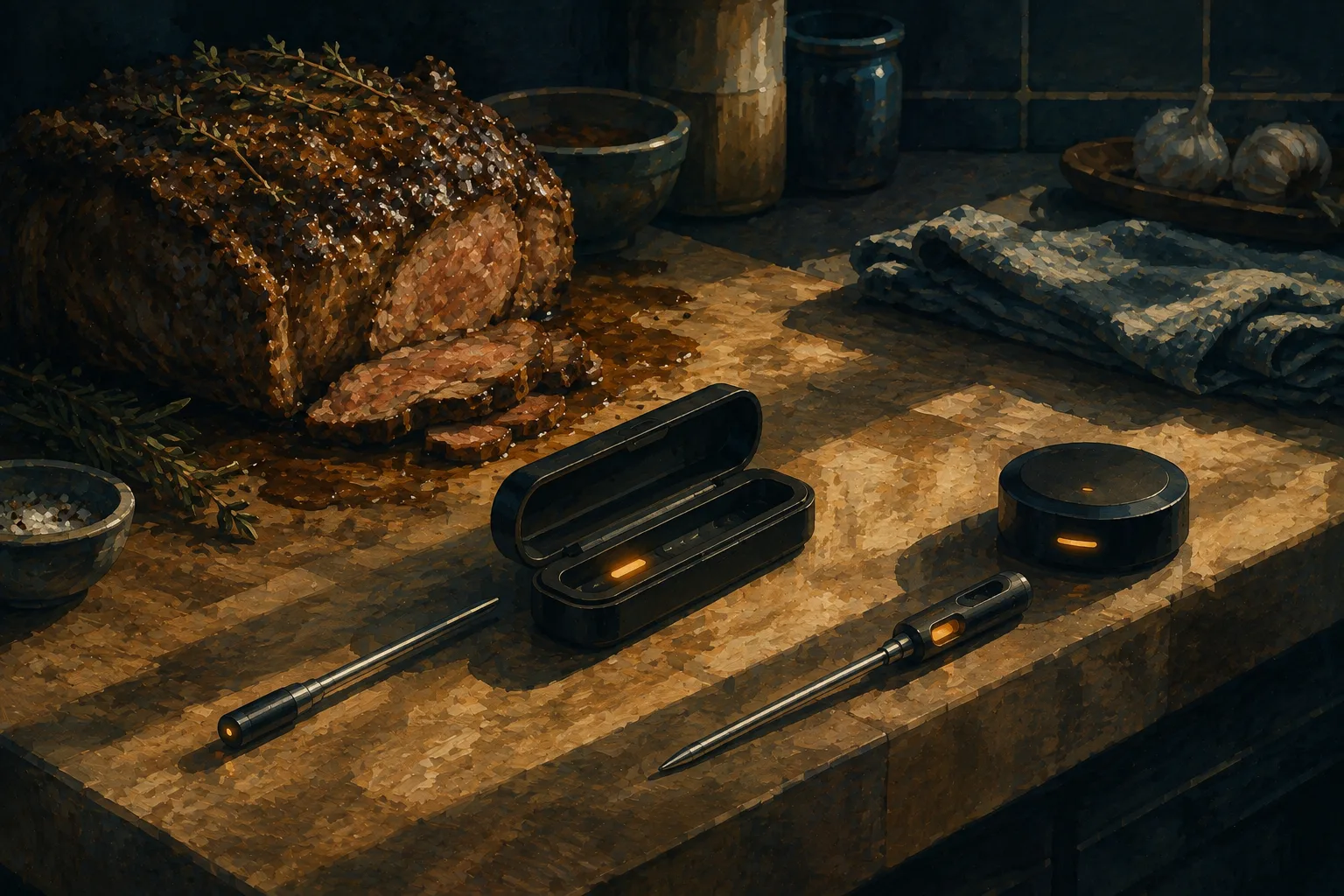
Illustration
Contents
- One probe, two names
- The short table
- Sensors solve placement, not prediction
- What "predicted time" actually means on each box
- The ambient reading: what each maker actually discloses
- Connectivity architecture, not the feet on the box
- Software you're trusting to keep working
- Price, this month
- What would change this
- What the connectivity record doesn't show
- Decision
- The evidence
- Sources
The short answer
On the single instrumented test each has, the Meater 2 Plus and the Combustion Predictive Thermometer measure food temperature about equally well, so don't buy on accuracy alone. Buy the Meater 2 Plus (Meater now sells it as the MEATER Pro) if you want one probe with its charger in the box and no WiFi hardware to add, mainly want a doneness alert rather than a predicted finish time, and can treat its ambient reading as a rough signal near the food rather than a cooker thermometer; on 28 October 2026 it cost less than Combustion's base probe, and still less once Combustion's WiFi Booster or Display was added. Buy the Combustion Predictive Thermometer if you want the more deeply audited accuracy record (on prior-generation hardware), an open developer-friendly Bluetooth protocol, and WiFi monitoring that doesn't need a second phone; the Booster or Display that makes WiFi work is a paid add-on, and Meater's own built-in WiFi answer is its Pro Duo or Pro XL. If you just need to know when the chicken hit 165°F, a much cheaper instant-read pen answers that question better than either of these.
On the one independently instrumented accuracy test each has, the Meater 2 Plus and the Combustion Predictive Thermometer land within a few tenths of a degree of their claims (E·07, E·09). That's not this comparison's finding so much as its starting point, because it settles almost nothing about which probe to buy. What actually separates them is what happens after the probe goes into the meat: how each one talks to your phone, whether its predicted finish time is anything more than a claim on a spec page, and what its ambient reading, the number that isn't touching your food, was ever built to tell you. None of it means anything if you can't trust what happens between the probe and your phone: does the countdown know something real about your specific piece of meat, or is it guessing the way a stranger at the store might guess how long your turkey needs, and is that second number, the one that isn't touching the meat, telling you your smoker actually hit temperature or something else entirely?
We read both makers' current spec pages and support documentation, pulled Combustion's open developer resources, and leaned on AmazingRibs' instrumented tests of both product lines along with owner reports on connectivity. One flag before we start: we infer that AmazingRibs' Combustion test ran on the first-generation probe rather than the 2nd-generation hardware sold today, based on the review's own mention of a newer, WiFi-equipped release the tested unit lacked; on that basis we treat the accuracy record as a starting point rather than a certificate for the current unit (E·09). These are two different manufacturers, so nothing here is a single company's evidence counted twice.
One probe, two names
A housekeeping matter first, because it changes which numbers below you can trust unlabeled and which you can't. Meater's own product page at meater.com/products/meater-2-plus returns a 404. The company's current store instead sells the same probe design as "MEATER Pro," part of a new Pro Collection; its own US store's meater-2-plus URL redirects straight to that MEATER Pro listing, and outside retailers, including Traeger's accessories catalog, sell the identical probe under the combined name "MEATER Pro / 2 Plus" (E·01, E·20). Meater appears to have folded the 2 Plus into a renamed, repositioned line rather than discontinuing it. Our MEATER Pro review follows that rename and the probe's own evidence in one place.
That would be a simple renaming story except the numbers don't fully agree. AmazingRibs' own review, live and last updated 2026-07-10, still tests and prices this hardware under the Meater 2 Plus name, and its spec box lists the ambient/handle rated to 932°F (500°C), a manufacturer-claimed 250-foot Bluetooth range, and a street price below Meater's own list price (E·19, E·07). Meater's current MEATER Pro manufacturer page states the same handle rated to 1000°F and a 2,500-foot open-air Bluetooth claim (E·01). We found no change log or press note reconciling that gap, so we treat it as unresolved rather than picking a winner between the two figures: every spec below is labeled by which page or review it came from, and a MEATER Pro manufacturer number is never presented as a confirmed Meater 2 Plus number, or the reverse.
The short table
| Attribute | Meater 2 Plus | Combustion Predictive Thermometer |
|---|---|---|
| Sensors | 6 total: 5 internal along the probe, 1 ambient in the handle (E·01, E·19) | 8 total: 4 lower-probe (T1-4), 3 upper-probe (T5-7), 1 ambient (T8); TrueCore locates the slowest-heating point automatically (E·02, E·04) |
| Claimed accuracy | ±0.5°F to 221°F internal, per both the current MEATER Pro page and AmazingRibs' live Meater 2 Plus spec box; ambient: Meater states within 5°C / 9°F of the temperature at the sensor's own location, unverified by anyone outside the company (E·01, E·19, E·23) | segmented by zone: T1-4 ±0.4°F to 149°F, ±0.5°F to 185°F; T5-7 ±0.9°F to 221°F; T8 ambient ±2.7°F to 212°F, widening to ±8.1°F by 900°F (E·02) |
| Independently measured (worst case) | 0.3°F off on food; ambient read 7°F low at 32°F and 11°F high at 212°F in one test (E·07, E·08) | within 0.3°F throughout the food range, on the probe we infer to be the prior generation (E·09) |
| Temperature range | 221°F internal limit; handle/ambient rated to 932°F (500°C) per AmazingRibs' live Meater 2 Plus spec box, versus 1000°F on the current MEATER Pro manufacturer page (E·19, E·01) | -5 to 900°F rated; continuous operation to 750°F (E·02) |
| Water/dust rating | waterproof, dishwasher safe; no IP number published (E·01, E·19) | IP69K (E·02) |
| Connectivity architecture | Bluetooth from the probe to the charger, which relays to your phone; farther needs a second phone or tablet on WiFi running MEATER Link/Cloud, or the Pro Duo or Pro XL with built-in WiFi (E·19, E·21, E·25, E·26) | Bluetooth direct to the probe, or an optional Booster/Display relays over WiFi through Combustion's MeatNet mesh without your phone in range (E·02, E·14) |
| Bluetooth range claimed | 2,500 ft open air and 250 ft typical home range on the MEATER Pro page; Meater's Pro Support Guide gives up to 33 ft probe to charger and up to 250 ft charger to device (E·01, E·26) | 330+ ft line of sight (E·02) |
| WiFi | none built in on the one-probe Pro; a second phone or tablet running MEATER Link/Cloud as a WiFi bridge, or the Pro Duo or Pro XL (E·21, E·25) | optional, via a paid Booster or Display accessory (E·14) |
| Predicted finish time | app estimates cook time from internal and ambient readings plus the protein you select; no independent timed test found (E·05, E·24) | Prediction Engine models heat flow to estimate remaining time; AmazingRibs' timed cook at a 130°F target was 7 minutes optimistic at its first checkpoint, a cook taken higher hit the stall with a much less accurate prediction, and later grill and oven tests were reported as pretty good (E·03, E·10, E·27) |
| Open developer access | none found; closed app ecosystem | open-source, MIT-licensed Bluetooth framework and example apps on GitHub (E·15) |
| Price (checked 28 October 2026) | Meater's page lists the one-probe Pro below Combustion's base probe; AmazingRibs lists it lower still under the Meater 2 Plus name (E·01, E·07) | Bluetooth-only base probe; the WiFi Booster and WiFi Display bundles each cost more than the base probe (E·14) |
Sensors solve placement, not prediction
Both probes throw more sensors at the same problem: you rarely push a leave-in probe tip to the exact geometric center of a roast, so a single sensor at the tip can read a hotter or colder spot than the true core. Meater spreads 5 sensors along the food end of the probe (E·01). Combustion spreads 8 across its probe and calls the feature that identifies the coolest reading TrueCore, built to "pinpoint the slowest-heating part" without you having to aim for the center (E·04). More sensors along the shaft is a real, checkable engineering claim: it widens the zone where a probe still finds something close to the true core.
It is also a completely different claim from "predicts your finish time accurately." A probe can nail placement tolerance and still guess badly at how long the food has left, because that second problem depends on heat flow through the specific piece of meat, the cooker's actual temperature stability, and an algorithm nobody outside the company can inspect. Sensor count is architecture. Prediction is software running on top of it. Don't let one vouch for the other.
What "predicted time" actually means on each box
Combustion is explicit that this is the product's headline feature: a "physics-based Prediction Engine" that "creates a virtual model of your food based on heat flow" to estimate the minutes remaining (E·03). That is Combustion's own description of its method. It is a claim about mechanism, not a result, until someone times it against a clock.
AmazingRibs did exactly that, and more than once. In the detailed cook, started in a 325°F oven at 1:51 p.m. with a 130°F target, the app's first prediction at 2:00 p.m. said 13 minutes to go, meaning done around 2:13. An update at 2:11 p.m. revised that down to 6 minutes. The food actually hit target at 2:20 p.m., seven minutes later than the first prediction implied (E·10). The reviewer noted the estimate sharpened as the cook got closer to done, which tracks with how a physics model should behave: more data, less error. A cook taken to a higher temperature went differently: it hit the stall and the prediction was much less accurate. The reviewer then reports that later tests at higher temperatures in a grill and oven found the predictions pretty good, getting better as the cook progressed (E·27). That is a small, mixed record. It shows the engine can land close and can miss badly in the stall. It cannot give you a typical error rate.
Meater's app also estimates cook time, but by a different route: Meater says its estimator uses the probe's internal and ambient readings and the protein you select, and runs them through "a special algorithm" it does not publish, rather than a stated physics model (E·22, E·24). We found no independent timed test of that estimate in this packet, on either probe's carryover-adjusted number or Meater's. That's a real gap in the record, not a point for either brand.
The ambient reading: what each maker actually discloses
This is where the two products stop looking like variations on the same idea. Meater's own FAQ, published on its Australian regional support mirror, explains the mismatch structurally rather than with a single blunt admission: built-in cooker thermometers typically measure a different spot from where the food sits, commonly the back of an oven or the lid of a grill, so the ambient sensor is deliberately built to read the air right at the food end of the probe instead, and a lower-than-expected reading feeds directly into the app's cook-time estimate rather than reporting the cooker's set temperature (E·05). Meater's primary US support article, which we could read on 2026-10-12 after an earlier 403, says it plainly: "IMPORTANT! The ambient sensor is NOT designed to measure or confirm your cooking appliance's set temperature" (E·22). The same article states a tolerance for the sensor's own location: "accurate within 5°C / 9°F of the temperature at its location" (E·23). That is a different thing from the 9°F/5°C figure Meater uses elsewhere for when the ambient number appears at all on older probes. Meater's own language, reproduced by an enthusiast site that compiled its FAQ, adds that the sensor was deliberately built to react to microclimates, including the cool pocket of air a cold roast creates around itself as it goes into the cooker (E·06).
AmazingRibs' own ambient test landed inside that same structural gap. Testing at 32°F and 212°F because the reviewer's calibration rig couldn't fit the probe's handle at other points, the readings came back 25°F and 223°F, 7 degrees low and 11 degrees high (E·08). Held against Meater's stated within 5°C / 9°F tolerance (E·23), the 7-degree-low reading is inside the band and the 11-degree-high reading is outside it. It is one unit and one reviewer's reference setup, and a bath has no meat in it, so it is a calibration check and not evidence about the cool air around a cold roast; it is too thin to call Meater's spec wrong, and it keeps the spec from being a guarantee.
Combustion's probe carries an ambient sensor too, the eighth of its eight, and, like Meater, Combustion publishes a numeric tolerance for it, though a banded one: plus or minus 2.7°F up to 212°F, widening to plus or minus 4.5°F up to 572°F and plus or minus 8.1°F up to 900°F (E·02). That is a checkable spec, tighter at moderate cooking temperatures than Meater's single band of 5°C / 9°F (E·23), and it gets looser as the reading climbs into smoker and grill territory. What Combustion has not published, in the material we reviewed, is Meater's kind of structural explanation for why the ambient reading diverges from the cooker's set temperature in the first place; and we found no independent instrumented test of Combustion's ambient sensor to check its published tolerance against. So the two products both document an ambient limitation, but in different registers: Meater discloses in prose why its number and the cooker's dial should be expected to diverge and gives one wide tolerance for the sensor's own spot, Combustion discloses in a spec table how loose the number is allowed to get at each temperature band, and neither the prose nor the spec table has been checked against a thermometer bath the way each maker's food probe has. Our deeper look at what a Meater's ambient reading actually measures unpacks that gap further, including where the company's own explanation holds up to independent re-verification and where it doesn't.
Connectivity architecture, not the feet on the box
Headline range claims tell you almost nothing without the architecture behind them. The one-probe Meater is Bluetooth only, but not in a straight line from probe to phone: the probe talks to the charger, which acts as a booster and talks to your phone (E·19). Meater's Pro Support Guide gives a figure for each hop, up to 33 feet from probe to charger and up to 250 feet from charger to your device, and says to keep the charger as close to the cooker as possible (E·26). Meater's product page separately claims 2,500 feet in open air against a 250-foot typical home figure (E·01), so Meater's own documents give different numbers. Go beyond Bluetooth and you need MEATER Link or MEATER Cloud, which use a second phone or tablet on your WiFi as the bridge (E·21), or Meater's WiFi tier, the Pro Duo and Pro XL, which Meater says have WiFi built in (E·25). Our MEATER Pro review walks through the range figures.
Combustion's base probe is also Bluetooth only, claiming 330-plus feet line of sight (E·02). The difference shows up once you add the optional Booster or Display, a paid step up from the base probe (E·14). Either accessory can repeat the probe's Bluetooth signal and, because it carries its own WiFi radio, push data to Combustion's cloud without your phone anywhere nearby. That's a different architecture from the one-probe Meater's second-phone bridge, though Meater's Duo and XL now answer it with WiFi built in (E·25). It also means Combustion's WiFi convenience is something you buy separately, not something built into the base probe. If what you actually want is dedicated relay hardware from the start rather than an optional add-on, our comparison of the ThermoWorks RFX against the Meater 2 Plus covers a system built around exactly that.
Real-world reports for both split on distance in ways a spec sheet can't predict. Engadget's Meater 2 Plus review reported walking "from my deck all the way to the mailbox on the street without losing connection" (E·18). AngryBBQ's review of the same probe reported occasional drops working through multiple walls on the far side of a house, and a reader comment on that same review described frequent disconnects at just 2 feet with a newly purchased unit (E·17). Two houses, two probes, two very different stories. Connectivity for this class of product depends on your specific walls, your specific unit, and your specific router more than any single review can pin down.
Software you're trusting to keep working
Both of these are wireless products whose usefulness lives partly in an app that neither company is obligated to keep updating forever. When we rechecked on 28 October 2026, both apps were still shipping updates: Meater's iOS release history showed releases in August and September 2026 (E·12), and Combustion's showed releases in August and October 2026, the August one adding cook history and notes (E·13). An earlier version of this comparison read an older Combustion release date as a sign of a neglected app; that reading no longer holds. Meater's app also sets a floor on the phone you need, iOS 14 or later or Android 8.0 or later (E·11). Combustion also ships firmware updates to the probe and its Booster or Display hardware through the same app.
Combustion is also the more open of the two by a real, checkable margin: it publishes an MIT-licensed Bluetooth framework for iOS and Android on GitHub, describing it plainly as the library "for communicating with Combustion Inc. Predictive Thermometers" (E·15). That's meaningfully different from a closed app you can only use the way the manufacturer designed it, and it matters if you'd ever want your probe's data in a smart-home dashboard rather than just the maker's own screen. We found no equivalent open framework for Meater in this packet.
Neither company is free of documented software growing pains. Early Combustion adopters on the Pitmaster Club forum described a firmware lockup where a probe stopped connecting after an update, one owner writing that it "never works again" (E·16). Combustion support said a fix was coming. A beta fixed one of that owner's two probes but not the other, and after several rounds of email the thread ended with the second probe still dead; we found no later resolution (E·16). That is one early report, not a pattern, and not a settled fix either, but it's worth knowing before you buy into an ecosystem that updates its own hardware over the air.
Price, this month
On 28 October 2026, AmazingRibs listed the Meater 2 Plus below Meater's own manufacturer price for the one-probe Pro (E·07, E·01); Engadget had priced the same probe higher in its 2023 review, so this is a product whose street price moves (E·18). Combustion's Bluetooth-only base probe sat above both, and its WiFi Booster and WiFi Display bundles each cost more than the base (E·14). Line those up and the one-probe Meater is the cheaper way into this category, and it stays cheaper even after you add Combustion's WiFi accessory. That is not a like-for-like WiFi comparison, because the one-probe Meater has no WiFi of its own; Meater's closer match is the Pro Duo or Pro XL, which we did not price against Combustion's bundles (E·25). Exact figures live in the evidence ledger with their retrieval dates, because they change.
What would change this
An independent instrumented test of the current 2nd-generation Combustion probe, at the same rigor as AmazingRibs' test of what we infer was the first-generation unit, would either confirm the accuracy record on today's hardware or complicate it. More timed tests of the Prediction Engine, published with their clock times across cut sizes, cooker types and finishing temperatures, would turn a handful of reports, one of them a single cook that ran seven minutes optimistic, into an actual error range, including how it behaves in the stall. A quantified dropout rate for either probe, gathered across more than a handful of reviewer yards and forum threads, would replace the current pile of contradictory anecdotes with something closer to a number. And an independent instrumented test of Combustion's ambient sensor, checked against the segmented tolerance the company already publishes, would close a testing gap that currently applies to both probes' ambient readings; a re-opened Meater US support page, or any citable secondary source that reproduces its wording, would also let a future pass state a Meater location-accuracy figure this one could not.
What the connectivity record doesn't show
- Whether the current 2nd-generation Combustion probe matches the accuracy record AmazingRibs measured on what we infer was the first-generation unit; no independent instrumented test of today's hardware turned up in this packet (E·09).
- How often either probe's connectivity actually drops in a typical backyard. Every report we found, on both sides, is a single reviewer's or owner's experience, and they disagree with each other by a wide margin (E·17, E·18).
- How accurate Combustion's Prediction Engine is in general. The material we reviewed has one detailed timed cook, optimistic by seven minutes at its first checkpoint, one cook taken higher that hit the stall with a much less accurate prediction, and a later report of pretty good results in a grill and oven (E·10, E·27).
- Whether Combustion's published ambient tolerance, plus or minus 2.7°F up to 212°F widening to plus or minus 8.1°F by 900°F, holds up under an independent instrumented test; we found none for the ambient sensor on either probe, so both ambient figures rest on the manufacturer's own numbers rather than a third-party check (E·02, E·08).
- Whether Meater's stated ambient tolerance, within 5°C / 9°F of the temperature at the sensor's location (E·23), holds up. It is Meater's own spec; the one independent bath test is mixed against it (7°F low, inside; 11°F high, outside) and rests on a single unit (E·08).
- Whether the Pitmaster Club forum's firmware lockup was a widespread early-batch problem or a handful of unlucky units, and whether it was ever resolved for the poster's second probe; we found no later report either way (E·16).
For the much simpler question of whether the chicken actually hit a safe temperature, that's a job for a cheap instant-read pen checked against a known reference, not a $100-plus leave-in probe with a prediction engine attached. Our guide to claimed versus independently measured accuracy walks through exactly that audit-depth question for instant-read pens: some accuracy claims on a spec sheet have been checked once, some many times, and some not at all, and that gap between categories matters more here too than the tenth of a degree printed on either box. Correction, 28 October 2026: an earlier version described the Meater as Bluetooth direct to the phone, called AmazingRibs' seven-minute-optimistic cook the one independent timed test, said Combustion's lockup had been fixed, framed an older Combustion app date as neglect, and gave dollar figures for Combustion's WiFi add-ons that Combustion has since raised. Each is corrected above, and prices now sit in the ledger with their dates.
Decision
Both probes measured within a few tenths of a degree of their claims in the one independent instrumented test each has, so this is not really an accuracy contest. It splits on connectivity architecture, on whether the predicted finish time is checkable or just a claim, and on what the ambient reading was ever built to tell you.
Meater 2 Plus, if
- · You want a single probe with its charger in the box and no WiFi hardware to buy; on 28 October 2026 it cost less than Combustion's base probe, and less again once Combustion's Booster or Display is added (E·01, E·14)
- · You mainly want a doneness alert for one piece of meat rather than a predicted finish time, and you're fine treating the ambient reading as a rough microclimate signal near the food, not a cooker thermometer (E·05, E·06)
- · You're buying on price; AmazingRibs listed it lower still than Meater's own page, and both sat below Combustion's Bluetooth-only starting price on 28 October 2026 (E·01, E·07, E·14)
Combustion Predictive Thermometer, if
- · You want the more deeply audited accuracy record in this pair; AmazingRibs' instrumented test came within 0.3°F, matching the Meater 2 Plus's own instrumented result, though that record belongs to the prior-generation probe, not the one currently sold (E·09, E·07)
- · You cook large cuts where a genuine remaining-time estimate has value, and you're willing to treat Combustion's Prediction Engine as unproven until you've watched it run on your own cook; AmazingRibs' timed cook at a 130°F target was 7 minutes optimistic at its first checkpoint, a cook taken higher hit the stall and the prediction was much less accurate, and later grill and oven tests were reported as pretty good (E·10, E·27)
- · You or a developer in your household wants to build on an open, MIT-licensed Bluetooth framework rather than a closed app ecosystem (E·15)
- · You want WiFi monitoring without a second phone or tablet; the Booster or Display relays over WiFi on its own once purchased, while Meater's built-in WiFi starts at the Pro Duo (E·02, E·14, E·25)
Neither, if
- · You need a calibrated dome or chamber thermometer reading; Meater documents its ambient sensor as not designed to measure or confirm the cooking appliance's set temperature (E·22), and Combustion publishes a segmented ambient tolerance that widens sharply at high heat, from plus or minus 2.7°F up to 212°F to plus or minus 8.1°F above 572°F (E·02), so neither vendor's ambient reading replaces a dedicated pit probe
- · You want zero risk of a dropped connection; both have documented owner reports of connectivity trouble, from Bluetooth dropouts reported on the Meater side (E·17) to a Combustion firmware lockup where the poster's second probe was still dead when the thread ended and we found no later resolution (E·16)
A decision rule, not a winner: comparisons restate the individual reviews’ evidence, they never compute a combined score.
Meater 2 Plus (current manufacturer listing: MEATER Pro)
Official page not a paid link
We currently have no affiliate or commercial relationship with MEATER; this link goes to the manufacturer’s official product page.
Combustion Inc Predictive Thermometer
Official page not a paid link
We currently have no affiliate or commercial relationship with Combustion; this link goes to the manufacturer’s official product page.
The evidence
Every E·NN marker in the article is a link into this ledger: the claim, the exact words of the source, where it comes from, and how sure we are. Each entry links back to the section that cites it.
Meater's current manufacturer product page for this hardware line, now titled MEATER Pro and sold as part of a Pro Collection, lists 6 total sensors, 5 internal along the probe plus 1 ambient sensor in the handle, rated to 221°F internal with plus or minus 0.5°F accuracy and up to 1000°F at the ambient end, fully waterproof including the dishwasher, Bluetooth 5.2 Coded PHY long range claimed at 2,500 ft open air and 250 ft typical home range, and a $99.99 price.
'open air range is 2,500 ft, with a typical home range of 250 ft'
Counter-evidence considered
meater.com/products/meater-2-plus 404s outright, and Meater's own store redirects that same URL to this MEATER Pro page (E·20). AmazingRibs' independently maintained review, live and last updated 2026-07-10, still tests and prices this hardware under the Meater 2 Plus name, and its own spec box diverges from this manufacturer page on two figures: a 932°F ambient rating instead of 1000°F, and a 250 ft Bluetooth range claim instead of 2,500 ft open air (E·19). We found no change log or press note reconciling the two, so every spec in this comparison is labeled by the page or review it came from rather than blended into one number.
Combustion's current spec page for the 2nd-generation Predictive Thermometer lists 8 sensors delivering what it calls Total Temperature Awareness: 4 lower-probe thermistors (T1-4), 3 upper-probe IC sensors (T5-7), and 1 ambient sensor (T8). The accuracy claim is segmented by zone, not one number: T1-4 read plus or minus 0.4°F from 14 to 149°F and plus or minus 0.5°F from 149 to 185°F; T5-7 read plus or minus 0.9°F from 14 to 221°F; T8, the ambient sensor, reads plus or minus 2.7°F from 14 to 212°F, widening to plus or minus 4.5°F from 212 to 572°F and plus or minus 8.1°F from 572 to 900°F. The page also lists a rated range of -5 to 900°F with continuous operation to 750°F, an IP69K rating, a 330-plus-foot Bluetooth range claim, and a $149 price for the Bluetooth-only unit.
'±0.4°F (0.2°C) from 14-149°F (-10 to 65°C)'
Counter-evidence considered
The page states each zone's tolerance separately; quoting only the lower-zone 0.4°F figure, as this ledger's first pass did, understates the upper-probe tolerance and makes the ambient sensor look like an undocumented gap when it is in fact a published, if wide, spec. What Combustion has not published, unlike Meater, is a plain-language statement of what its ambient reading is and isn't meant to confirm; see the ambient section of this comparison for that distinction.
The same page describes the prediction feature as a physics-based Prediction Engine that models the food's heat flow to forecast the remaining cook time, which is Combustion's own description of its method rather than an independently measured accuracy figure.
'Our physics-based Prediction Engine™ creates a virtual model of your food based on heat flow'
Counter-evidence considered
This is Combustion's own description of its method, not a third-party measurement of how close its time estimates land in practice; see the AmazingRibs timed test elsewhere in this comparison (E·10).
Combustion's homepage describes a feature called TrueCore that identifies the slowest-heating point in the food automatically across the probe's 8 evenly spaced sensors, so the cook does not have to place the tip at the exact geometric center.
'TrueCore® pinpoints the slowest-heating part with 8 evenly spaced sensors'
Counter-evidence considered
This addresses placement tolerance, a sensor-architecture claim, not whether the predicted finish time is accurate; the two should not be conflated (E·03, E·10).
MEATER's own FAQ, published on its Australian regional support mirror, explains the ambient-versus-cooker mismatch structurally: built-in cooker thermometers typically measure a different spot from where the food sits, such as the back of an oven or the lid of a grill, so the probe's ambient sensor is deliberately built to read the air right at the food end of the probe instead. The same page states that a lower-than-expected ambient reading changes the app's cook-time estimate, meaning the number functions as an input to that prediction rather than a report of the cooker's set temperature.
'built-in thermometers in cooking appliances measure the temperature in a different spot from where you put your food'
Counter-evidence considered
This explains a structural reason the two numbers diverge and how the reading feeds the app's time estimate, but it is not a numeric location-accuracy figure and not the verbatim 'NOT designed to measure or confirm' sentence some older drafts of this comparison quoted. That sentence, and the 5°C / 9°F location-accuracy tolerance, are on MEATER's US support article, which returned 403 when we first tried it and was re-opened with a browser user-agent on 2026-10-12; both are restored verbatim as E·22 and E·23. The meater.com.au mirror used here does not contain them.
MEATER's own language, reproduced by an enthusiast reviewer who compiled its ambient-sensor FAQ, says the probe measures air temperature directly at the ceramic tip and was deliberately designed to be sensitive to hot and cold microclimates inside the cooker, including the cool air bubble a cold piece of meat creates around itself.
'so that our probe can detect the temperature that your food is actually being exposed to'
Counter-evidence considered
This compiled FAQ is a secondary reproduction of Meater's language rather than a screenshot of the live page, so we hold it at medium confidence pending a direct re-open of Meater's own article.
↩ First cited in “The ambient reading: what each maker actually discloses”
AmazingRibs' instrumented test of the Meater 2 Plus food probe read 134.7°F, 159.9°F and 205°F against 135°F, 160°F and 205°F references, calling the results excellent, and the reviewer awarded a Gold Medal and 4 stars; the spec box carries an item price of $80 that AmazingRibs marks as subject to change.
'The measured values were 134.7, 159.9, and 205° – excellent results.'
Counter-evidence considered
One purchased unit against the reviewer's own reference bath; the review does not name the reference instrument used to set the target temperatures.
The same review's ambient-probe check, run at 32°F and 212°F because the tester's calibration equipment could not accommodate the probe's handle at other points, read 25°F and 223°F, a deviation of 7°F low and 11°F high.
'The measured values were 25° and 223°F.'
Counter-evidence considered
MEATER's own documentation explains why its ambient reading is expected to diverge from a cooker's set temperature at all (E·05), but publishes no independently verifiable numeric location-accuracy figure to check this specific result against; whether it reflects a genuine miss, the test conditions, or the boundary-layer effect (a cold or hot piece of food chilling or heating the pocket of air right around the probe's handle) isn't something this one test resolves.
AmazingRibs found the Predictive Thermometer within 0.3°F throughout the food temperature range, including a 100°F reference reading 100.0°F, and awarded it 5 stars and a Platinum Medal. We infer the tested unit was the first-generation probe rather than the 2nd-generation hardware sold today, based on the review's own mention of a newer release the tested unit lacked.inference
'Throughout the food temperature range, the probe was within 0.3°F, an excellent result.'
Counter-evidence considered
The review never labels its unit 'first-generation' outright. Our inference rests on one signal instead of a direct statement: the review's own text notes 'A second-generation Predictive Thermometer has been released that can sustain higher temperatures, has a longer run-time, and has Wi-Fi built in,' capabilities the reviewed unit did not have (the review's $229 item price used to be a second signal, but a current Combustion WiFi Display bundle now lists at the same figure, so we no longer rely on it). The 2nd-generation unit sold today carries the same 8-sensor architecture per Combustion's marketing (E·02), but we found no independent instrumented re-test of the current hardware in this packet.
The same review independently timed the predictive algorithm on one detailed cook with a 130°F target: placed in a preheated 325°F oven at 1:51 p.m., the app's first prediction at 2:00 p.m. estimated 13 minutes remaining, a 2:11 p.m. update revised that to 6 minutes, and the food actually reached target at 2:20 p.m., 7 minutes later than the first prediction implied.
'I started the cook by placing the apparatus into a pre-heated (325°F or 163°C) oven at 1:51 p.m.'
Counter-evidence considered
One detailed cook at a 130°F target; a single timed run cannot establish a general error rate for the Prediction Engine, and the reviewer notes accuracy improved as the cook got closer to the target. The same review also reports a cook taken to a higher temperature where 'it hit the stall and the prediction was much less accurate', and later tests at higher temperatures that went better (E·27).
MEATER's own compatibility documentation requires iOS 14 or later, or Android OS 8.0 or later with Google Play Services, and states every supported device must support Bluetooth 4.0 or above.
'Apple phones and tablets running iOS version 14 or later'
Counter-evidence considered
None found; this is Meater's own current requirements page. Requirements can change with future app updates without changing this article's text.
The MEATER app on the Apple App Store keeps shipping updates: on 2026-10-28 its release history showed 5.1.0 on August 27 and 5.2.0 on September 11, 2026, with a newer build after them. The quoted release note belongs to the earlier 5.0.0 release (August 6, 2026), a redesigned Home and Explore section.
'a completely redesigned Home and Explore'
Counter-evidence considered
App Store version numbers change frequently; this is a snapshot on 2026-10-28, not a permanent fact, so the article cites the cadence and not the numbers. Android version numbering may differ from iOS.
The Combustion Inc. app on the Apple App Store was updated after our first retrieval: on 2026-10-28 its release history showed 3.3.0 on August 30, 2026, adding Cook History, notes and support for Combustion Engine, and 3.3.1 on October 11, 2026, minor fixes. The quoted release note belongs to the older 3.2.1 release (February 18, 2025), a rounding fix between the Live Activity and in-app display.
'Fix for rounding differences between the Live Activity and in app display'
Counter-evidence considered
Our first retrieval (2026-08-25) read the 3.2.1 date as a stale app; the later releases show it was not. App Store snapshots change, so the article cites the cadence and not the numbers.
On 2026-10-28 Combustion sold the Predictive Thermometer as a $149 Bluetooth-only unit with no WiFi; the bundle with a WiFi Booster listed at $199 and the bundle with a WiFi Display at $229 (our first retrieval on 2026-08-25 read $189 and $199), meaning WiFi relay is a paid hardware add-on rather than a built-in feature of the base probe.
'Predictive Thermometer with WiFi Booster'
Counter-evidence considered
Prices are current-listing snapshots and rose between our two retrievals; a two-probe WiFi Display bundle was also listed, which changes the per-probe math for buyers monitoring two foods at once.
Combustion publishes its Android Bluetooth Low Energy framework as open source under an MIT license, describing it as the library for communicating directly with its Predictive Thermometers, with a matching iOS framework and example apps in the same GitHub organization.
'Bluetooth Low Energy framework for communicating with Combustion Inc. Predictive Thermometers.'
Counter-evidence considered
Open-source client code is not the same as a stable published protocol contract; we found no explicit versioned specification document in this packet, only working framework repositories, so third-party integrations should expect the protocol to evolve with firmware.
Early Combustion owners on the Pitmaster Club forum reported a firmware lockup in which a probe stopped connecting after an update, described by one owner as a unit that after updating firmware 'never works again,' affecting two probes for the original poster. Combustion support said a fix should come; a beta fixed one of the poster's thermometers but not the other, and after four rounds of email the poster was still trying to get approval to send the probes in. The thread does not say the problem was resolved.
'never works again'
Counter-evidence considered
This is an early-adopter thread from December 2023 and January 2024 about a specific firmware-update failure mode; we found no later resolution and no way to confirm how widespread the issue was or whether it recurs on current firmware. An earlier version of this ledger said the manufacturer shipped a fix; the thread does not support that.
AngryBBQ's review reported occasional Bluetooth dropouts when working on the far side of the house through multiple walls, calling them infrequent and brief, while a reader comment on the same review reported frequent disconnections at a distance of only 2 feet with a recently purchased unit.
'when working on the other side of the house through multiple walls'
Counter-evidence considered
The reviewer's and the commenter's experiences directly contradict each other at very different distances, which is itself the honest finding: connectivity reports for this probe vary by unit or environment more than a single review can resolve.
↩ First cited in “Connectivity architecture, not the feet on the box”
Engadget's review tested the Meater 2 Plus on smoked turkey, chili, meatloaf and reheated leftovers, reported walking from a deck to a street mailbox without losing the Bluetooth connection, found no issues with high-heat use, and listed the price at $119.95 on Meater's own site at review time.
'I was able to venture from my deck all the way to the mailbox on the street without losing connection'
Counter-evidence considered
One reviewer's yard, at an unstated but modest distance, with testing skewed toward sub-350°F cooks; this single positive range report sits alongside AngryBBQ's mixed dropout reports at very different distances (E·17), and neither pins down a reliable real-world range.
↩ First cited in “Connectivity architecture, not the feet on the box”
AmazingRibs' own spec box for the unit it tested under the Meater 2 Plus name lists the handle/ambient end rated to 932°F (500°C), calling it 'the highest I've seen on any competing product,' a manufacturer-claimed Bluetooth range of 250 ft, five food sensors plus one ambient sensor, a waterproof dishwasher-safe body, and describes the connectivity architecture as the probe communicating with a charger/range booster over Bluetooth 5.2, which in turn talks to the phone.
'rated at 932°F (500°C), the highest I've seen on any competing product'
Counter-evidence considered
This spec box is the reviewer's own restatement of manufacturer figures for the specific unit purchased under the Meater 2 Plus name, not an independently measured maximum, and it diverges from the current MEATER Pro manufacturer page's 1000°F ambient figure and 2,500 ft open-air Bluetooth claim (E·01), a gap this comparison discloses rather than resolves.
Meater's own US store redirects this product's meater-2-plus URL to a page titled 'MEATER Pro | The Next Generation of MEATER,' and independent retailers, including Traeger's accessories catalog, sell the identical probe under the combined 'MEATER Pro / 2 Plus' name, indicating Meater folded the 2 Plus into a renamed Pro Collection rather than discontinuing it.inference
'MEATER Pro | The Next Generation of MEATER'
Counter-evidence considered
Neither Meater's store nor its product pages state in plain language that the 2 Plus was renamed; we infer the rename from the URL redirect, the combined product naming used across multiple storefronts and retailers, and the matching 5-internal-plus-1-ambient sensor architecture. No public change log confirms whether any internal component changed alongside the name.
MEATER's own support documentation describes MEATER Link and MEATER Cloud as requiring a second phone or tablet, signed into the same account and connected to the same WiFi network, to act as a Bluetooth-to-WiFi bridge for the probe; without that second device, the connection stays direct Bluetooth only.
'Your second smart device will serve as a bridge from your MEATER product's Bluetooth to your home's WiFi.'
Counter-evidence considered
None found: this is Meater's own current explanation of how Link and Cloud work, an article updated May 26, 2026. It returned a 403 to automated retrieval in August; on 2026-10-28 the sentence was confirmed verbatim on a direct page load.
MEATER's own US support article on the ambient sensor says the sensor measures the air temperature directly outside the meat, that it helps estimate cook time, and, in an IMPORTANT note, that the ambient sensor is not designed to measure or confirm the cooking appliance's set temperature.
'IMPORTANT! The ambient sensor is NOT designed to measure or confirm your cooking appliance's set temperature.'
Counter-evidence considered
A design-intent statement, not a measurement. It was cut on 2026-09-12 only because the page returned 403 to automated retrieval; re-opened with a browser user-agent on 2026-10-12 (the page shows 'Updated May 28, 2025'). Support pages can change without notice.
↩ First cited in “What "predicted time" actually means on each box”
The same MEATER support article states an accuracy tolerance for the ambient sensor: it is accurate within 5°C / 9°F of the temperature at its location, and the article adds right after that the sensor is not meant to show the appliance's set temperature.
'The ambient sensor is accurate within 5°C / 9°F of the temperature at its location.'
Counter-evidence considered
A manufacturer's own specification, not independently verified, and a single wide band rather than Combustion's banded tolerance (E·02). It is scoped to the sensor's own location, not the cooker. It is a different figure from the 9°F/5°C display threshold MEATER documents for dashes on the ambient reading. The article does not say how the tolerance was tested.
MEATER's Cook Time Estimate support article says the app's cook estimator uses the probe's internal and ambient temperature readings, along with the type of protein selected at the start of the cook, to calculate when the meat will be ready to remove from the heat, and that it accounts for the continued temperature rise during the rest period. It does not publish the algorithm.
'The cook estimator in the MEATER app uses the probe's internal and ambient temperature readings, along with the type of protein you select when starting a cook'
Counter-evidence considered
Names the inputs, not the model or its error; the same article says the estimator does not account for a stall or for wrapping. We found no independent timed test of MEATER's estimate.
Meater's Pro page says the one-probe MEATER Pro has no built-in WiFi and that buyers who want built-in WiFi should choose the MEATER Pro Duo or the MEATER Pro XL, which makes those two models Meater's own WiFi answer to Combustion's Booster or Display.
'If you want built-in WiFi, choose the MEATER Pro Duo or MEATER Pro XL.'
Counter-evidence considered
A manufacturer statement about its own lineup. We did not price the Duo or XL against Combustion's WiFi bundles, and the Duo and XL are different products from the one-probe model the AmazingRibs test covers.
Meater's Pro Support Guide describes the connection as probe to charger to smart device, with open-air, line-of-sight figures of up to 33 ft (10 m) from probe to charger and up to 250 ft (75 m) from charger to device, and advises keeping the charger as close to the cooking appliance as possible. It does not repeat the 2,500 ft figure on the product page.
'Probe to charger: Up to 33ft/10m'
Counter-evidence considered
Two Meater documents give different range figures (E·01), and neither is an independent measurement. Reviewer reports of real-world range vary widely (E·17, E·18).
The same AmazingRibs review, updated July 9, 2026, reports a cook taken to a higher temperature where the probe hit the stall and the prediction was much less accurate, and then says the reviewer later tested the Prediction Engine at higher temperatures in a grill and oven and found the predictions pretty good, getting better as the cook progressed.
'Meathead later tested it at higher temperatures in a grill and oven and found the predictions to be pretty good'
Counter-evidence considered
The review gives the 130°F oven cook with clock times (E·10) but, as far as we could read, not timings for the later grill and oven tests, so 'pretty good' is the reviewer's judgment and not a measured error range. The stall result is also a single cook: 'When I cooked the sock to a higher temperature it hit the stall and the prediction was much less accurate'.
Built from the documented record: specifications, manuals, published measurements and owner reports, each itemized in the evidence ledger above. How we work
Sources
- 01MEATER Pro (current manufacturer page for the Meater 2 Plus product line) · official product page
- 02Predictive Thermometer (2nd Generation) · Combustion Inc product page
- 03Ambient Temperature Sensor · MEATER Support
- 04MEATER Ambient Sensor Questions · Naked Whiz Ceramic Charcoal Cooking
- 05Meater 2 Plus Review And Rating · Meathead's AmazingRibs.com (Bill McGrath)
- 06Combustion Predictive Thermometer Review And Rating · Meathead's AmazingRibs.com (Bill McGrath)
- 07Which mobile devices support the MEATER app? · MEATER Support
- 08MEATER Smart Meat Thermometer · App Store listing
- 09Combustion Inc. App · App Store listing
- 10Thermometers · Combustion Inc product collection
- 11combustion-inc/combustion-android-ble · GitHub repository
- 12Combustion Predictive Thermometer Lockup · Pitmaster Club forum
- 13MEATER 2 Plus Review: Great Accuracy In A Small Package · AngryBBQ
- 14Meater 2 Plus review: A more precise and durable wireless meat thermometer · Engadget (Billy Steele)
- 15Better cooking starts here · Combustion Inc homepage
- 16MEATER Pro / 2 Plus | The Next Generation of MEATER · MEATER US store (meater-2-plus URL redirects here)
- 17How to Use MEATER Link and Cloud · MEATER Support
- 18FAQs · MEATER Australia (regional support mirror)
- 19Cook Time Estimate in the MEATER App · MEATER Support
- 20MEATER Pro Support Guide · MEATER Support