Precision kitchen · Review
Research-basedThermapen ONE review: the well-measured pen ThermoWorks is saying goodbye to
ThermoWorks' farewell notice, its two-band accuracy spec, an independent four-point audit and a cheaper pen audited the same way, assembled into one research-based verdict on the pen ThermoWorks is retiring.
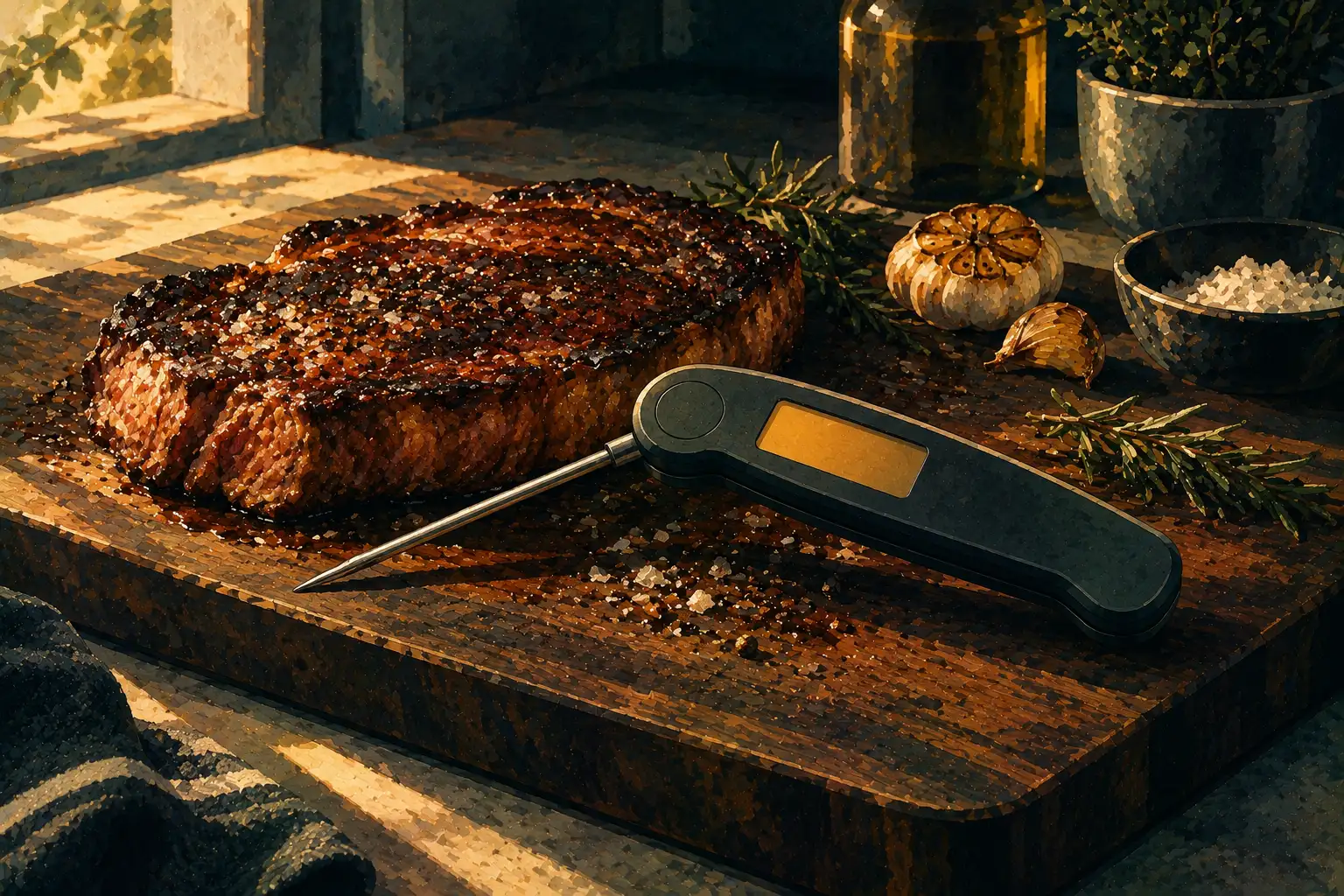
Illustration
Contents
- Who this is for
- A farewell on the product page
- The accuracy claim has two bands
- What one second means
- A cheaper pen, measured the same way
- Built for the hand, not the oven
- Scorecard
- What would change our conclusion
- Against the alternatives
- What the closeout leaves unsettled
- The decision
- Verdict
- The evidence
- Sources
The short answer
The Thermapen ONE is well supported but no longer the future: on 11 October 2026 ThermoWorks' own page says it is time to say goodbye and names the 0.4-second Thermapen NANO as the successor (E·01, E·02). In an independent audit of one unit the pen read within half a degree at four points, and ThermoWorks says the five-year warranty is unchanged (E·10, E·04). That ±0.5°F holds only from -4 to 248°F; beyond it the published tolerance is ±1.8°F (E·06). A far cheaper ThermoPro stayed within 0.6°F in the same audit format, so occasional checkers can skip it (E·14).
ThermoWorks has told its customers to say goodbye to the Thermapen ONE. The company's own product page, read on 11 October 2026, says "it's time to say goodbye," promises the pen is still the fastest and most accurate "for now," and tells shoppers to stay tuned for what comes next (E·01). What comes next is already taking orders: the Thermapen NANO, which ThermoWorks calls the ONE's definitive successor (E·02). Anyone shopping for the pen that other thermometers get measured against is looking at a product with an expiry date.
That changes the question. A flagship review asks whether the pen earns its price. This one asks whether a pen that is leaving the market still earns a purchase, and what a buyer gives up or keeps if they take it before the stock runs out. We opened ThermoWorks' ONE and NANO pages, read the manual, the comparison chart and the trim procedure, and went back to the independent audits for a pen that is cheaper by a wide margin. Every number carries a marker like (E·06) pointing to the claim behind it.
Who this is for
- You check doneness all day, every day, and want a pen with an independent audit behind it while stock lasts. This page covers the current Thermapen ONE (SKU THS-235-447). Strong fit (E·06, E·10, E·05).
- You own an older Classic Thermapen and want the longer warranty and faster claimed response. ThermoWorks' own chart lists one against two years of warranty (E·07). Good fit.
- You check a chicken or steak a few times a week. A cheaper pen with a published audit is enough, and the section on it below shows why (E·14).
- You need to watch a roast for hours, or measure above 248°F. Different tools, covered in the sections below (E·06, E·16).
A farewell on the product page
The notice is plain. The ONE's product page carries a closeout banner and a farewell paragraph, and at retrieval only two standard colors, red and blue, were offered at the closeout price, alongside two limited-edition colors at the regular one. ThermoWorks' own chart from May 2025 listed ten colors (E·01, E·07). That fits a product being sold down.
Two cautions keep this from overreading. The page never uses the word discontinued, and "for now" leaves room for more stock. We found no last-sale date. And the only dissent we found is a UK retailer's guide that calls the NANO a next generation rather than a replacement. We couldn't date the farewell notice, so the guide may predate it, and a reseller has reason to keep the older pen looking current (E·17).
The NANO itself claims a 0.4-second response, about 1000 hours of battery life against the ONE's 2,000, built-in magnets, and a tighter tolerance between 248 and 392°F (E·03). Those are ThermoWorks' numbers for a pen whose page is taking pre-orders, with shipments scheduled to begin in October. The only independent measurement we found is a speed timing of a pre-production unit, dated 13 August 2026, with no accuracy audit (E·03, E·18). Correction, 20 October 2026: the first version of this review said no independent measurement of the NANO existed. That timing was already published on 13 August 2026 and we missed it. Nothing in the record says the ONE got worse, and we make no claim about hardware revisions, because ThermoWorks publishes no changelog for it.
What a buyer keeps is the useful part. ThermoWorks says "nothing has changed" with the ONE warranty (E·04). The manual gives five years against defects in components or workmanship, repair or replacement at the company's discretion, and a separate repair service for a pen damaged for any reason (E·05). What nobody has stated is how long ONE-specific parts will stay in stock, so the parts question is open.
The accuracy claim has two bands
The ONE's accuracy is usually quoted as a half degree. The product page is more careful: ±0.5°F from -4 to 248°F, and ±1.8°F from -58 to -4°F and from 248 to 572°F (E·06). ThermoWorks' own comparison chart prints plus or minus 0.5°F with no band at all, so a shopper who reads only the chart gets a rosier picture (E·07). For roasts, steaks, poultry and sous vide, every temperature that matters sits inside the tight band. For candy, deep frying and oven spot-checks it doesn't.
The independent record is one audit. AmazingRibs logged one ONE unit at 32.0, 130.1, 225.5 and 325.3°F against reference points near 32, 130, 225 and 325°F, and gave it a Platinum Medal (E·10). Read plainly, that confirms those four readings on that unit. It doesn't establish how much units vary from each other, the page doesn't name its reference instrument, and the 225°F reading sits exactly on the half-degree limit rather than comfortably inside it. The 325°F point also falls in the wider band, where the spec allows ±1.8°F and the pen read 0.3°F high.
Two other ThermoWorks documents get mistaken for independent checks, and neither is. The NIST-traceable certificate that ships with every unit shows that the unit was tested in the company's A2LA-accredited lab against measurements traceable to NIST (E·08). It documents traceability for that unit at that moment. It doesn't say NIST certified the product, and nobody has published how far a kitchen-used pen drifts afterward. The ice-bath trim procedure is ThermoWorks' own owner guidance: a reading between 31.5 and 32.5°F needs no action, and the pen should rarely need adjustment (E·09). It works at a single point, so it can't catch error elsewhere in the range.
What one second means
ThermoWorks claims a one-second response, and its manual defines that conservatively: within 1°F of an ice bath's actual temperature in one second, with other foods possibly varying (E·16, E·07). Independent evidence is thinner than it looks. AmazingRibs lists about a second for a 32 to 212°F step, but its reviewer writes that he is taking ThermoWorks' word on the 0.2-second time constant because his stopwatch can't measure that closely (E·11). Prudent Reviews, in a structured group test, got 1 second at the boil, 4 seconds in ice and 5 seconds in a 124°F sous vide bath, and the ONE was the only pen of six to hit the exact temperature in all three (E·12).
Both can be true. The pen reads fast and lands on the number, and the settled reading takes a few seconds in a gentle bath. For steaks, chops and burgers, a second or two is irrelevant. Where the claim matters is the NANO's marketing, which promises less than half the time (E·03), and one reviewer has frame-counted a pre-production NANO against a ONE, though only for speed (E·18).
A cheaper pen, measured the same way
The budget argument is the one that most weakens a recommendation for this pen. The same AmazingRibs reviewer ran the same four-point format on a ThermoPro TP-19. It read 32.0, 130.6, 225.5 and 325.0°F, a worst case of 0.6°F, with a response of 2 to 3 seconds, and earned a Gold Medal against the ONE's Platinum (E·14).
TempPro states a looser ±0.9°F with no band, and its own page sends shoppers who want tighter doneness control to another model (E·15). Those are fair cautions. They also describe a pen that costs well under half the ONE's list price and landed a tenth of a degree from it at the four points (E·14, E·15). An owner report of a moisture-related TP-19 failure keeps durability an open question, and one audited unit proves little about either pen. If you check doneness a few times a week, the extra money buys a faster settle and a longer warranty, not visible accuracy (E·05, E·11, E·14, E·15). Our cheap alternatives guide ranks the field by exactly that evidence.
Built for the hand, not the oven
The ONE is a spot-check instrument. The manual warns to protect the plastic body from high temperatures and not to leave the pen in an oven or on a hot surface, and the pen powers down after a set sleep time (E·16). Nothing in its specifications offers a cable, radio or alarm, which is our reading of a list that names none (E·16). Leave-in cooking belongs to a different product category.
Handling gets short praise. AmazingRibs names one gripe, no Hold button for the times the display is hard to read, and calls the five-year warranty very generous. It also calls the pen pricey, "but you only pay for it once" (E·13). The manual adds the usual folding-pen cautions: oils can work past the hub's O-ring seal, and the probe shouldn't be rotated while submerged (E·16).
Scorecard
Cernary scores are research-based: every number below traces to the ledger, and none of it comes from our own bench work. Methodology v1.1, equal weight across covered dimensions.
| Dimension | Score | Traced to |
|---|---|---|
| documented-performance | 88 | E·06, E·10, E·11, E·12 |
| design-construction | 82 | E·04, E·05, E·08, E·12, E·16 |
| documented-usability | 80 | E·09, E·13, E·16 |
| value-proposition | 65 | E·01, E·02, E·03, E·14, E·15 |
| Overall | 79 | medium confidence |
Documented-performance, 88. A four-point audit with every reading within half a degree is more than most pens have, and a second independent test landed all three bath readings on target (E·10, E·12). Held back by three facts: one unit, a stopwatch-limited speed figure (E·11), and a tolerance that widens above 248°F (E·06).
Design-construction, 82. A per-unit certificate, an IP67 body, a five-year warranty ThermoWorks says is unchanged, and a repair service for damage (E·04, E·05, E·06, E·08). Prudent Reviews also reports two drops without damage and a 20-minute submersion for its unit (E·12). Not higher because that is one pen, there is no long-term seal data, and the parts question for a closed-out model is open.
Usability, 80. An owner-run trim procedure and an audit with a single gripe (E·09, E·13). The Hold button is the miss, and the pen is not for ovens or leave-in use (E·16).
Value, 65. The ONE sells at a closeout price, which helps, but a successor is shipping (E·01, E·02, E·03) and a much cheaper pen stayed close in the same audit format (E·14, E·15). The score would be lower without the warranty.
What would change our conclusion
- An independent audit of the NANO. If it matches its claims on the same four points, the ONE's remaining edge is its closeout price alone, and the case for buying the older pen narrows to a stock-clearing bargain.
- Multi-unit accuracy data for the ONE. The audit describes one pen (E·10); wide scatter between units would demote the accuracy story to marketing.
- A ThermoWorks statement on parts and calibration service after the closeout. A stated support window would raise design-construction; silence leaves it where it is (E·04, E·05).
- Evidence of drift in used pens. The certificate is a factory snapshot (E·08).
Against the alternatives
The nearest premium rival is Typhur's InstaProbe, and our InstaProbe comparison sets the evidence on both pens side by side. The cheap end is the TP-19 above, with other options in the alternatives guide (E·14).
For the wider question of what claimed accuracy means and which pens have been measured, our accuracy pillar holds the category evidence. The NANO is the other option. Its speed has one independent frame-count of a pre-production unit, and its accuracy has no independent audit that we found (E·03, E·18).
What the closeout leaves unsettled
Three gaps are bigger than the usual evidence caveats, because each could change what you do. First, nobody has said how long ThermoWorks will stock ONE parts or how long the repair service for it will run; the warranty is the only support promise on record (E·04, E·05). Second, the audit tells us about one pen, so a buyer who needs half-degree certainty at a particular temperature should check their own unit in an ice bath (E·09, E·10). Third, the only independent NANO measurement is a speed timing of a pre-production unit, so any claim that it is tighter rests on ThermoWorks' own pages (E·03, E·18).
The decision
If you want an independently audited instant-read pen and you check temperatures every cook, the ONE on closeout is a sound purchase, the five-year warranty and repair service included (E·04, E·05, E·10). Buy it while stock lasts, check it once in an ice bath (E·09), and keep it in your hand rather than in the oven or on the grill grate (E·16).
If your cooking sits in the middle of the range, steaks, chicken, roasts and bakes, and you do it a few times a week, a cheaper pen with a published audit gets you the same answer (E·14, E·15). If you cook candy or fry at 350°F, the ONE's own spec widens to ±1.8°F up there and the premium buys less than it appears (E·06). And if you would rather wait for independent testing of the NANO, there is little cost to waiting for a few reviews, because the ONE's audit record will still be there, although the closeout stock may not be (E·02, E·03, E·10).
Verdict
The ONE has a four-point independent audit plus a three-bath group test and a warranty ThermoWorks says survives the closeout, but its ±0.5°F claim covers -4 to 248°F only, independent timings (1 s at the boil, 4 to 5 s in baths) differ from the one-second claim, and a much cheaper pen stayed close in the same audit. Scored 79 at medium confidence because the audit describes one unit, the NANO has no independent accuracy audit, and the product is leaving the market.
Best for
- · Cooks who check doneness constantly and want a pen with a four-point independent audit plus a three-bath group test, on a closeout, with the five-year warranty ThermoWorks says is unchanged
- · Anyone who wants an independently audited accuracy record rather than a spec-sheet promise: four readings within half a degree on one unit
- · Owners of an older Classic Thermapen who want the longer warranty and the faster claimed response without waiting for the NANO's first reviews
Avoid if
- · Budget decides it; a much cheaper ThermoPro TP-19 stayed within 0.6°F in the same four-point audit, and that is enough for occasional doneness checks (E·14, E·15)
- · You need precision above 248°F, such as candy, frying oil or smoker-chamber checks; the published tolerance there is ±1.8°F, not ±0.5°F (E·06)
- · You want to leave a probe in the food or watch a roast for hours; the ONE is a hand-held spot-check pen and says so in its manual (E·16)
What holds up
- · Four independent readings within 0.5°F of reference points near 32 to 325°F on one unit (E·10)
- · Per-unit NIST-traceable certificate and a single-point trim for owners (E·08, E·09)
- · Five-year warranty, with ThermoWorks saying it is unchanged by the closeout (E·04, E·05)
- · IP67 body, two drops and a 20-minute submersion survived in one group test, and a documented repair service for damage (E·05, E·06, E·12)
What doesn’t
- · Being closed out: ThermoWorks says goodbye and names the NANO as successor (E·01, E·02)
- · Published tolerance widens to ±1.8°F above 248°F and below -4°F (E·06)
- · Settling takes 4 to 5 seconds in ice and sous vide bath tests, not the claimed 1 second (E·12)
- · No Hold button, the one gripe in the most detailed audit (E·13)
By dimension
- documented-performance
- 88
- design-construction
- 82
- documented-usability
- 80
- value-proposition
- 65
Cernary score, methodology v1.1 · research-based. The score grades the documented record; confidence grades how much record exists.
ThermoWorks Thermapen ONE
Official page not a paid link
We currently have no affiliate or commercial relationship with ThermoWorks; this link goes to the manufacturer’s official product page.
The evidence
Every E·NN marker in the article is a link into this ledger: the claim, the exact words of the source, where it comes from, and how sure we are. Each entry links back to the section that cites it.
ThermoWorks' own Thermapen ONE product page, read on 11 October 2026, carries a farewell notice and a color closeout banner. The page says the pen is 'still the fastest, most accurate, and most recommended' for now and tells shoppers to wait for what comes next. Only two standard colors (red and blue) were offered at the closeout price, plus two limited-edition colors at the regular price; ThermoWorks' May 2025 chart listed ten colors.
The page reads 'say goodbye to Thermapen ONE' and ends 'stay tuned for what comes next.' Site banner: 'Thermapen ONE - Color Closeout.' The page's variant data lists Red, Blue, and two limited-edition colors.
Counter-evidence considered
The notice stops short of the word discontinued, and 'for now' leaves room for more stock; we found no ThermoWorks statement of a last-sale date. We could not open the deal site Homebrew Finds, whose search snippet says the final colors were down to three, so that detail is unconfirmed.
ThermoWorks' Thermapen NANO page names the NANO as the replacement for the ONE. The NANO was unveiled in August 2026, and the page answers the replacement question with a flat yes.
FAQ: 'The Thermapen NANO is the definitive successor to the Thermapen ONE.' It adds that 'The NANO was officially unveiled August 2026.'
Counter-evidence considered
One UK retailer guide, updated 8 August 2026, calls the NANO a next generation rather than a replacement and mentions no discontinuation (E·17). It is the only dissent we found, and we could not date the ONE page's farewell notice, so it may predate it (E·01).
On ThermoWorks' own specification tables, the NANO differs from the ONE in four ways that matter to a buyer: a 0.4-second response claim against 1 second, a tighter tolerance between 248 and 392°F (plus or minus 0.7°F, where the ONE's is plus or minus 1.8°F), about 1000 hours of battery life against the ONE's 2,000 hours, and built-in magnets. The page takes pre-orders: red is labeled as now shipping, blue and black are listed as shipping starting October, and six other colors starting November.
Banner: 'Readings in 0.4 seconds. The Fastest Thermapen Ever.' FAQ: 'about 1000 hours of battery life with Thermapen NANO.' Shipping: 'Blue, Black: Shipping starts October.' FAQ: 'all pre-order shipments are scheduled to begin shipping out in October.'
Counter-evidence considered
These are maker claims for a product whose page was still taking pre-orders, and our first search missed the one independent measurement that existed, The Barbecue Lab's frame-counted speed timing of a pre-production NANO dated 13 August 2026 (E·18), which covers speed only and no accuracy. ThermoWorks says the NANO keeps the ONE's IP67 rating, five-year warranty and NIST-traceable certificate, so the two are not different on those points. We make no claim about hardware or firmware revisions inside the ONE itself, because ThermoWorks publishes no changelog for it.
ThermoWorks says in its NANO FAQ that owners of the ONE keep their warranty, and that the NANO carries the same five-year term and is supported by the same US-based team in American Fork, Utah.
FAQ: 'Nothing has changed with your Thermapen ONE warranty.'
Counter-evidence considered
A web FAQ is a statement of current policy, not a contract term, and it says nothing about how long ThermoWorks will stock ONE-specific parts such as battery covers after the closeout ends (E·05).
The ONE's operating manual gives a five-year warranty against defects in components or workmanship, with remedy of repair or replacement at ThermoWorks' discretion, and separately lists a repair service for any ONE damaged for any reason. The manual names no registration step.
The warranty section opens 'full five-year warranty against defects' and promises a defective unit will 'be either repaired or replaced without charge.' Repair Services: 'full repair service for any Thermapen ONE damaged for any reason.'
Counter-evidence considered
The manual points to a separate terms page for liability details, which we did not read in full. The repair service is presumably paid for damage that is not a defect; the manual states no price.
ThermoWorks' product page specification table limits the plus or minus 0.5°F (0.3°C) accuracy to -4 to 248°F (-20 to 120°C). From -58 to -4°F and from 248 to 572°F the stated tolerance is plus or minus 1.8°F (1.0°C). The page lists a 1-second response, a Type K thermocouple, IP67, a 5-year warranty and 2,000 hours on one AAA battery.
The marketing copy says '0.5°F accuracy in key temperature ranges,' and the table's accuracy row splits into the two bands. The product page lists SKU THS-235-447 (Red) for this model.
Counter-evidence considered
ThermoWorks' May 2025 comparison chart prints plus or minus 0.5°F with no band (E·07), so a reader who sees only the chart gets a looser impression than the product page gives.
ThermoWorks' comparison chart dated 5/2025 separates the ONE from the older Classic Thermapen: 1-second against 1-2 seconds, plus or minus 0.5°F against plus or minus 0.7°F, a 5-year warranty against 2 years, 2,000 against 1,500 hours of battery, and ten colors against six. The ONE's accuracy row carries no temperature band.
Chart rows: 'Accuracy ±0.5°F (±0.3°C) ±0.7°F (±0.4°C)' and 'Warranty 5 years 2 years.'
Counter-evidence considered
The chart is a marketing summary; the product page's band-limited table (E·06) is the fuller statement of the same specification.
Each ONE ships with a calibration certificate that ThermoWorks describes as covering that individual unit, tested in its calibration lab, with measurements traceable to NIST. ThermoWorks says the lab is A2LA-accredited. The certificate documents traceability for the unit; the sources do not say NIST certifies the product.
Manual: measurements are 'traceable by an unbroken, documented' chain to NIST. Product page: 'NIST-traceable certificate from our A2LA-accredited calibration lab.'
Counter-evidence considered
A certificate documents the unit's state at the factory. No source we found quantifies drift after years of kitchen use.
ThermoWorks' own user check for the ONE is a single-point ice-bath test. A reading from 31.5 to 32.5°F needs no action, the company says the pen should rarely need adjustment, and a trim is available. This is manufacturer guidance for owners, not an independent audit.
The procedure trims 'at a single temperature point' and sets 'acceptable limits: 31.5°F and 32.5°F.' It adds the pen 'should rarely need adjustment.'
Counter-evidence considered
A one-point trim cannot correct a pen that is off elsewhere in its range. The procedure also needs a Phillips screwdriver to open the battery compartment.
AmazingRibs' chief thermometer reviewer logged one ONE unit at 32.0, 130.1, 225.5 and 325.3°F against reference points near 32, 130, 225 and 325°F, a worst case of half a degree at the 225°F point, and gave it a Platinum Medal. The page was last updated 9 July 2026.
Spec table rows: 'Actual Temp at 225 Degrees: 225.5' and 'Awarded 5 Stars / Platinum Medal.' The same table gives 32.0, 130.1 and 325.3 for the other points.
Counter-evidence considered
This is one unit at four points. It does not show how much units vary from each other, says nothing below 32°F or above about 325°F, and the page does not name its reference instrument. Half a degree at 225°F sits exactly on the ±0.5°F limit rather than inside it.
AmazingRibs lists about 1 second for the ONE on a 32 to 212°F transition, but its reviewer writes that the one-second response and 0.2-second time constant are ThermoWorks' figures and that his stopwatch cannot resolve them.
Review text: 'a time constant of 0.2 seconds' and 'to have to take their word for it' because the stopwatch cannot 'measure that closely.' Table row: 'Speed from 32 to 212 Degrees: ~1 sec.'
Counter-evidence considered
The table row is the reviewer's own entry and the stopwatch comment applies to the finer 99.3-percent claim; read together they support a settled reading in roughly a second at the 32 to 212°F step, not a precise figure.
In Prudent Reviews' group test the ONE averaged 1 second to read 212°F at the boil, 5 seconds to read 124°F in a held sous vide bath, and 4 seconds to read 32°F in ice. It was the only pen of the group to hit the exact temperature in all three tests. The same review reports the ONE survived two drops without damage and passed a 20-minute submersion test.
Sous vide: 'Averaged 5 seconds, reading 124°F.' Ice: 'Averaged 4 seconds, reading 32°F.' Boiling: 'Averaged 1 second, reading 212°F.' Durability: 'passed my 20-minute submersion test with no issues' and 'survived two drops without any damage or performance degradation.'
Counter-evidence considered
The test names no reference instrument for its baths, so 'exact' means agreement with the bath setting, not with a calibrated standard. Settling times of 4 to 5 seconds outside the boil are well above the maker's 1-second figure (E·06). The drop and submersion results are one reviewer's single unit, not a durability study.
AmazingRibs calls the ONE's five-year warranty very generous, names a missing Hold button as its only gripe, notes the pen is pricey, and awards it five stars and a Platinum Medal.
'The warranty is a very generous five years.' The closing verdict says the pen is pricey 'but you only pay for it once.'
Counter-evidence considered
One reviewer's opinion; no source we found compares the ONE's long-term durability with its cheaper rivals. Prudent Reviews reports two drops without damage and a 20-minute IP67 submersion for its unit (E·12), which is two events on one pen, not long-term seal data.
In the same four-point instrumented format, AmazingRibs logged a ThermoPro TP-19 at 32.0, 130.6, 225.5 and 325.0°F, a worst case of 0.6°F at the 130°F point, with a 2 to 3 second response, and gave it a Gold Medal.
Spec table: 'Actual Temp at 130 Degrees: 130.6' and 'Awarded 4 Stars / Gold Medal.' Table also gives 32.0, 225.5 and 325.0 and speed entries of 2 and 3 seconds.
Counter-evidence considered
One unit, one reviewer, and the TP-19's own tolerance claim is looser than the ONE's (E·15). A separate owner report in our alternatives guide describes a moisture-related probe failure after a few uses. Context: Prudent Reviews timed a related model, the ThermoPro TP19H, at 8 seconds at the boil, 6 in a sous vide bath and 5 in ice, its slowest pen overall (the E·12 source), well above the 2 to 3 seconds AmazingRibs logged for the TP-19.
TempPro, which now sells the TP19, states plus or minus 0.9°F accuracy with no temperature band, a 0.5-second response, IPX6 water resistance and a 3-year warranty after registration, at a price well under half of the ONE's regular list price at retrieval. Its own page points shoppers who want tighter doneness control to a different model.
'provides precise readings within ±0.9°F.' The page's Not Ideal For note: 'For tighter doneness control on steak or delicate fish.' Shipping banner: '3-year warranty after registration.'
Counter-evidence considered
The 0.9°F claim is looser than the ONE's 0.5°F in its band, but AmazingRibs' four readings for the TP-19 stayed within 0.6°F (E·14), so the claim is conservative against that one unit.
The ONE is a hand-held spot-check instrument. Its manual warns against leaving it in an oven or on a hot surface, the page describes auto-off sleep of 10 to 180 seconds that owners select, and it has no cable or wireless link for monitoring a roast over hours. The same manual defines the one-second claim narrowly, as a reading within 1°F of an ice bath's actual temperature in one second with other foods varying, and warns that oils can work past the hub's O-ring seal and that the probe should not be rotated while the body is submerged.inference
Manual: 'Protect the plastic body from high temperatures,' followed by a capitalized instruction not to leave the pen in an oven or on a hot surface. Speed: 'will read to within 1°F of the actual temperature of an ice bath within one second. Reading times in other foods may vary slightly.' Seal: 'oils can work their way past the seal and accumulate inside the hub and may cause failure.' Rotation: 'The probe should not be rotated while the body is submerged or under a stream of water.' Rating: 'immersion in water to 39" depth for up to 30 minutes.'
Counter-evidence considered
The no-wireless statement is our reading of the specification list, which names no probe cable, wireless radio or alarm. We found no ThermoWorks claim that the ONE can monitor continuously.
A UK retailer's NANO-versus-ONE guide, updated 8 August 2026, lists the same IP67 rating and 5-year warranty for both pens and calls the NANO the next generation after the ONE rather than a replacement.
The guide describes the ONE as one that 'remains a highly capable instant-read thermometer.'
Counter-evidence considered
A reseller selling both models has a reason to keep the older one looking current, and we could not date ThermoWorks' farewell wording on the ONE page, so the guide may predate it (E·01). We read it through a text extractor, not a browser.
The Barbecue Lab, in a review dated 13 August 2026, timed a pre-production Thermapen NANO against a Thermapen ONE by counting frames of high-speed video: .30, .24 and .28 seconds for the NANO in a 32°F bath against .79 seconds for a ONE, and .44 to .47 seconds at 130°F against 1.04 seconds. It measured speed only: the clock stops when the display is within 1°F of the bath, so it does not audit accuracy.
'measuring speed by counting frames of video'; 'we need to see 33 degrees on the display to stop the test'.
Counter-evidence considered
The unit was a pre-production sample and the reviewer allows a margin of error in his own method. The site blocks plain HTTP requests, so we read it in a browser on 20 October 2026. The page carries affiliate links to the pens. It says nothing about whether the settled reading is right to half a degree.
Built from the documented record: specifications, manuals, published measurements and owner reports, each itemized in the evidence ledger above. How we work
Sources
- 01Thermapen ONE · ThermoWorks product page (retrieved 2026-10-11)
- 02Thermapen NANO · ThermoWorks product page (retrieved 2026-10-11)
- 03Thermapen ONE Operating Instructions (ThermoWorks)
- 04ThermoWorks Thermapen Comparison Chart (5/2025)
- 05Thermapen ONE Trim Adjust Procedure (ThermoWorks)
- 06ThermoWorks Thermapen ONE Review · AmazingRibs.com (Bill McGrath)
- 07Best Instant-Read Thermometer? · Prudent Reviews
- 08ThermoPro TP-19 Review · AmazingRibs.com (Bill McGrath)
- 09TP19 Instant-Read Meat Thermometer · TempPro (formerly ThermoPro)
- 10Thermapen NANO vs Thermapen ONE: What's Changed and Which Should You Buy? · Smokey Rebel
- 11Thermoworks Thermapen Nano Review: Don't blink. · The Barbecue Lab (David Gafford, 13 August 2026)