Vacuum sealing · Review
Research-basedAnova Precision Vacuum Sealer Pro review: can it really seal liquids?
The marketing promises the juiciest of foods, no problem. Anova's own manual says to avoid liquids in the bag. We read both, plus the independent tests and the owner threads, to find out what this sealer actually does with moist food, marinades and free liquid.
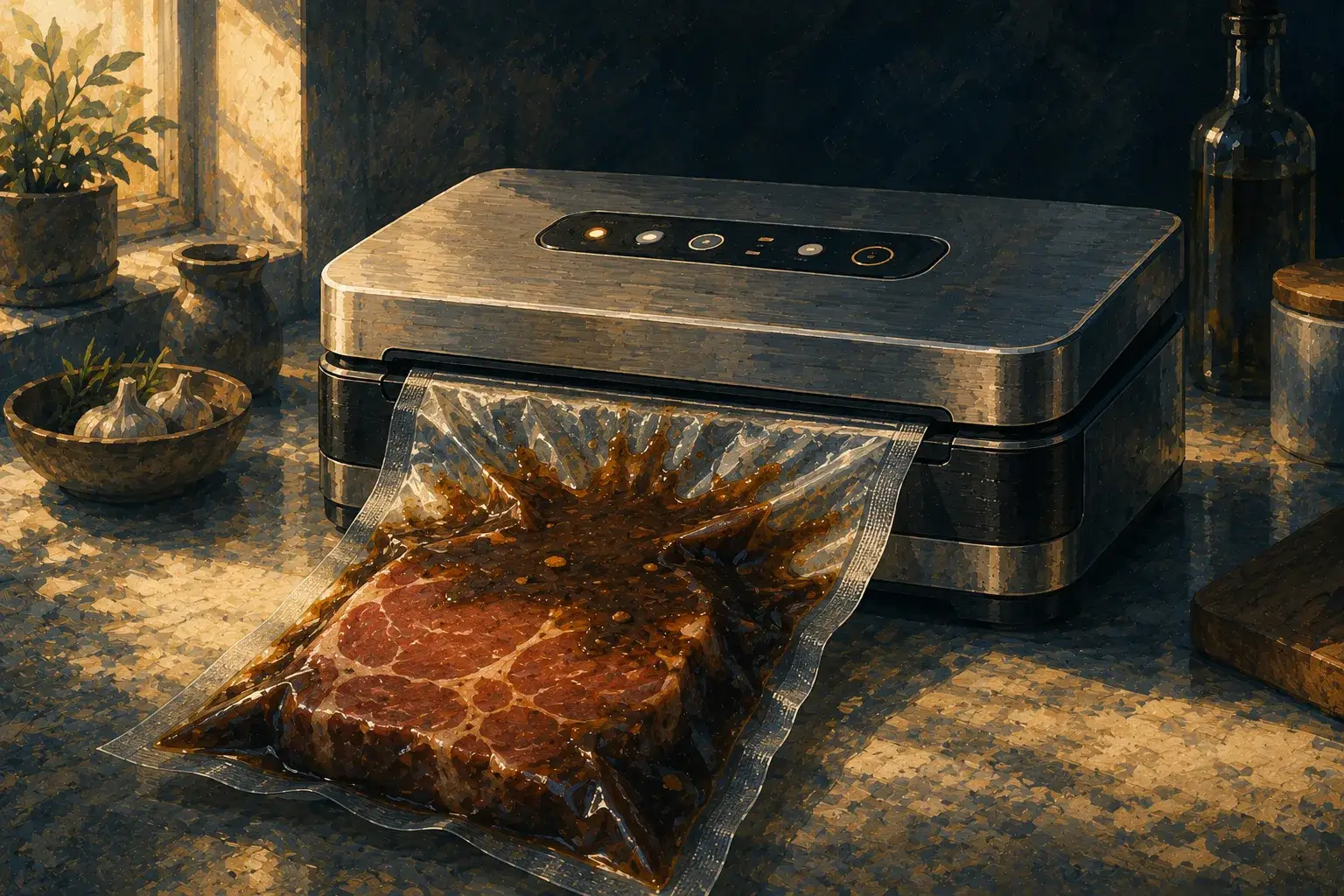
Illustration
Contents
The short answer
Buy it for moist food and technique-assisted marinades, not for pouring soup into a bag. Independent testers measured class-leading suction and a double seal that held through a sous vide bath, and America's Test Kitchen sealed foods with liquid especially well in wet mode. Free liquid is still the category's wall: Anova's own manual says to avoid liquids in the bag, and owners who bag soup freeze it first. Scored 75/100 at medium confidence.
Anova's own product page promises the Precision Vacuum Sealer Pro handles "even the juiciest of foods, no problem." Anova's own manual, a few clicks deeper, carries an icon of a bag of liquid with a line through it and the instruction "avoid using liquids in the bag" (E·03, E·05). Both sentences describe the same external suction sealer, which on 28 October 2026 sat at its regular price on Anova's own store, the sale that had run earlier having ended (E·02). A promise that specific, contradicted that directly by the company's own paperwork, deserves a real check, and the check turns out to depend on which of three different jobs you mean by "liquid."
A vacuum pump can't tell air from teriyaki; it pulls whatever reaches the mouth of the bag, and liquid moves far more willingly than pork. Somewhere between vacuum and seal, marinade starts to climb, and stop it in time or spend ten minutes fishing soy sauce out of a machine that was never built to drink. We read Anova's product page and its quick start guide, pulled America's Test Kitchen's verdict, an instrumented independent test and a hands-on review, and went through the forum threads where owners bag actual soup (E·01, E·04, E·08, E·09, E·11). No bench of our own, and two sources refused us entirely; we say so where it matters. Moist food, marinades, free liquid: the evidence answers each one differently, and the article walks them in that order. Every factual statement carries a marker like (E·05) pointing to the claim behind it.
Who this is for
- You cook sous vide and bag marinated meat or fish most weeks. This machine's wet-mode record is genuinely good. Strong fit (E·08, E·09).
- You batch-cook soups and sauces for the freezer and don't mind freezing them before sealing. Good fit, with technique (E·06, E·11).
- You want to vacuum unrestricted liquid straight from the pot. No external sealer does this; read the mechanism section, then our chamber guide.
- You mostly seal chips, crackers and bread. Look elsewhere; the record on delicate food is poor (E·09).
The promise on the box
Anova's pitch leans directly into the category's sore spot. The product page says the machine "was built with a low pressure suction function and a reliable double sealer to handle even the juiciest of foods, no problem," and elsewhere promises "the ability to seal wet foods without worry" (E·03). That's aimed at anyone who has ever mopped marinade out of a vacuum port, and Anova knows its audience: the same paragraph name-checks the fear of "sucking up excess liquid into the vacuum port" (E·03).
The hardware around the promise is straightforward. 110 watts, a 12 L/min extraction rate, a double heat seal, built-in roll storage with a cutter, an accessory port for vacuuming containers, and a 2-year warranty (E·01), plus moist and dry presets and a pulse button for manual control (E·04). Anova rates it for over 100 continuous seals, a bulk-day figure nobody has independently tested (E·01).
The manual tells a different story
Marketing copy is written by one department and manuals by another, and on this machine they disagree. The quick start guide defines Moist as a "Pre-setting for moist and marinated food (i.e. meat, fish, etc.)" and explains the pulse workflow: press to vacuum in bursts, then "Press seal when desired vacuum is achieved" (E·04). Reasonable so far.
Then, on the care page, an icon: a bag of liquid with a line through it, captioned "Avoid using liquids in the bag" (E·05). The troubleshooting table backs it up. The first listed cause of a failed seal is liquid or oil on the bag edge (E·05). The company that promises the juiciest of foods, no problem, instructs its owners in writing not to put liquids in the bag. Both sentences are Anova's.
For what it's worth, getting to that manual took some doing. Anova's support pages refused our automated retrieval, so we opened them in a browser, where the official guide turned out to be a PDF hosted on Google Drive (E·04). The Williams-Sonoma mirror of the same manual blocked us too, and when we went back on 28 October 2026 the Drive copy asked for a sign-in, so the manual quotes in this article rest on our August reading (E·04, E·05).
Why suction machines and free liquid don't mix
The contradiction resolves once you look at how an external sealer works. It grips the bag's open mouth and pumps air out through it, which means everything in the bag gets pulled toward the machine. Solids stay put. Free liquid flows, and unfrozen liquids end up in the pump if nothing stops them (E·06). No wet mode changes that geometry; lower suction just slows the race between full vacuum and marinade reaching the seal bar.
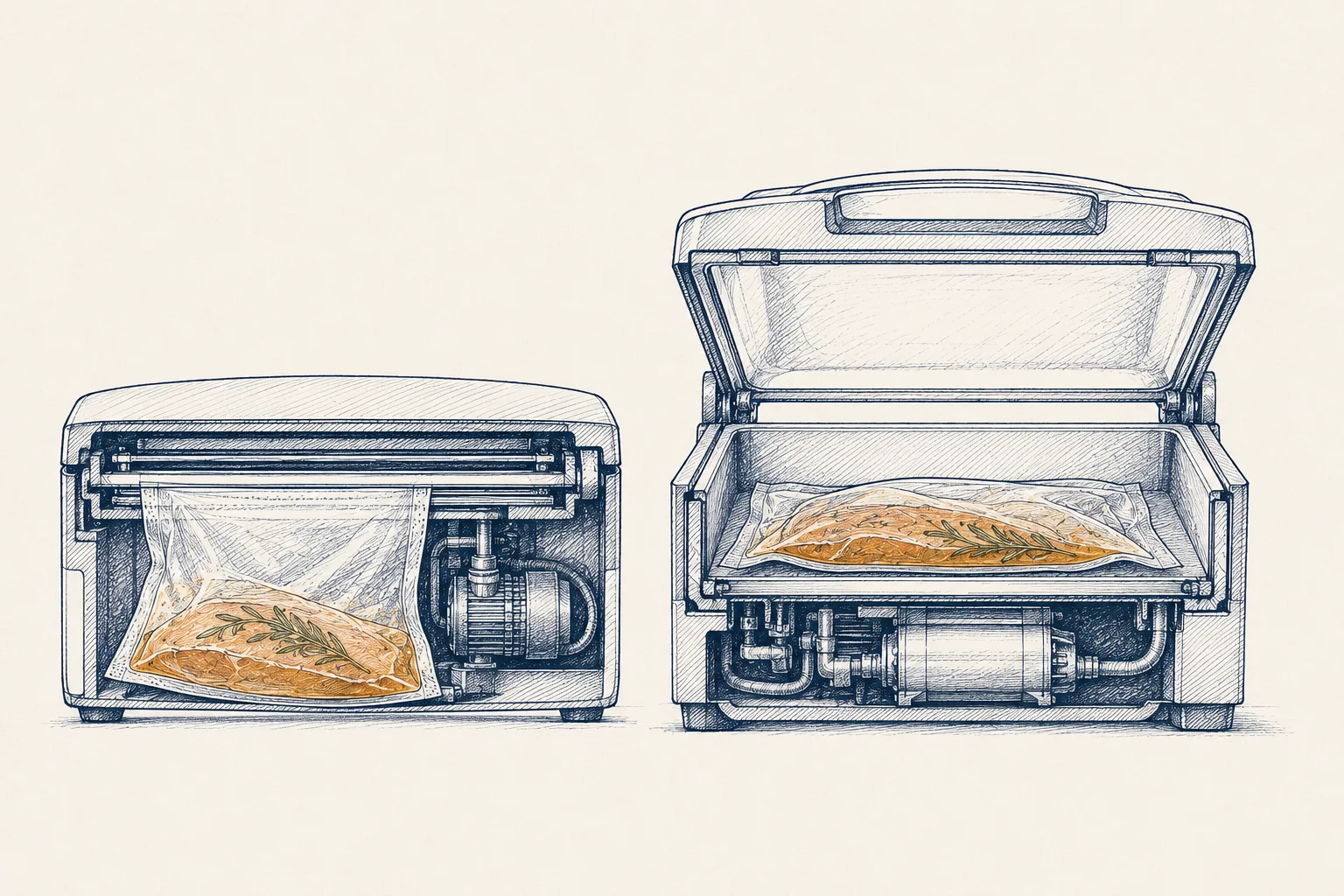
The standard workaround is decades old: stand the bag upright in the freezer for 1 to 3 hours first, not to freeze it solid, just until water-based liquids and fats firm up enough that they "won't be sucked into the vacuum packer," after wiping the bag mouth clean inside and out (E·06). The machines that genuinely seal sloshing liquid are chamber sealers, which evacuate a chamber around the entire bag so the pressure on the liquid is equal in every direction. Even manufacturers describe chambers as "ideal for preserving liquid or liquid-rich foods" (E·07). Different architecture, different physics, roughly triple the counter commitment.
What the testers measured
Nobody has published an instrumented free-liquid test of this machine. What exists is still worth having, even though every figure below describes a single unit on a single bench; whether your own unit hits 68 kPa is not something this table can promise.
| Source | What was measured | Result |
|---|---|---|
| Shouldit (instrumented) | Peak suction | 68 kPa in 36 seconds, highest in their database (E·09) |
| Shouldit (instrumented) | Moist-mode sous vide bag | Perfect first attempt, no leakage through the bath (E·09) |
| Shouldit (instrumented) | Crunchy-food load | 40% of load broken; no gentle mode (E·09) |
| America's Test Kitchen | Vacuum strength | 76.87% (E·08) |
| America's Test Kitchen | Wet and dry foods over time | "reliably kept all sorts of dry and wet foods perfectly sealed" (E·08) |
The suction figure beats the FoodSaver tested on the same bench, which pulled 63 kPa (E·09). ATK's testers went out of their way to praise the wet mode, saying it let them "seal foods with liquid especially well," with their only quibble a flimsy zip-style bag cutter that sometimes jammed (E·08). And a hands-on reviewer who ran marinated meat through it describes the moist mode doing exactly what Anova claims at the moist-food level: reduced suction, sealed bag, no fluid in the system (E·10).
Read the wording closely, though. "Foods with liquid" is a steak in its marinade, not a quart of stock. Every documented success above involves food carrying liquid. None involves free liquid alone, which is the case the manual warns about (E·05). Nobody quantifies exactly how much free liquid the moist mode actually tolerates; the record brackets the answer between "a marinade clinging to meat, fine" (E·08, E·10) and "don't put liquids in the bag" (E·05), and that bracket is as precise as this evidence gets. Serious Eats has reportedly rated this machine highly too; seriouseats.com blocks our crawler outright, so we could not read the original and it earns no marker here.
What owners do with actual soup
The most useful data on the free-liquid question comes from Anova's own forum, in a thread bluntly titled "does it really seal liquids?" The opening post states the category prior: "Non chamber vacuum sealers tend to be abysmal with liquids" (E·11).
The thread then staged a small experiment in evidence quality. Its most confident reply reported vacuum-sealing two chicken legs in a cup of marinade, "worked perfectly." Three days later the same poster retracted: he'd been using Anova's chamber sealer the whole time (E·11). The wet-sealing success stories that survive all come with technique attached. One owner reports that "Sealing liquids works fine" but that the machine "fails safe, and drains to the bilge," a catch basin that "must be cleaned out after every significant use," and that he presses Seal manually the moment liquid nears the seal area (E·11). Another: "I freeze sauces and soup routinely" before bagging (E·11).
That manual-seal reflex is a learned skill with a failure mode. In an earlier thread about Anova's original sealer, an owner describes pressing Seal "as soon as I see any liquid heading towards the sealer," and adds the operative caveat: "The more liquid, the more difficult it is to time" (E·12). The Pro's controls run the identical play, pulse then seal (E·04). Practiced owners win that race most of the time. The machine is designed to survive the times they don't, which is what the drip basin is for (E·11).
Scorecard
Cernary scores are research-based: every subscore traces to the ledger, and none of it is our own bench work. Methodology v1.1, equal weight across covered dimensions.
| Dimension | Score | Evidence |
|---|---|---|
| documented-performance | 80 | E·05, E·08, E·09, E·10 |
| design-construction | 72 | E·01, E·08, E·10, E·11 |
| documented-usability | 78 | E·01, E·04, E·09, E·11, E·12 |
| value-proposition | 68 | E·02, E·07, E·08, E·13 |
| Overall | 75 | medium confidence |
Performance sits at 80 on the strongest measured suction in one lab's database, a moist-mode seal that survived a water bath on the first try (E·09), and ATK's over-time wet-food endorsement (E·08). It doesn't go higher because the free-liquid ceiling is documented by the manufacturer's own manual (E·05) and because the machine wrecked 40 percent of a crunchy load (E·09).
Design-construction lands at 72. The double seal is confirmed by two independent hands-on sources (E·09, E·10), the body is plastic with a 2-year warranty (E·01), and the fail-safe drip basin is a genuinely sensible piece of wet-food engineering (E·11). Against that: ATK's jamming cutter (E·08), a basin that demands cleaning after every wet session (E·11), and no published teardown or long-term reliability record at all; the "over 100 continuous seals" duty figure is Anova's own, untested by anyone outside the company (E·01).
Usability scores 78. One-handed operation, clearly separated presets and a pulse button that gives you manual control are all documented (E·01, E·04). Wet work needs technique and timing that the marketing never mentions (E·11, E·12), and the bench test flagged dim indicator lights and no completion chime (E·09).
Value scores 68, down from 75. The earlier score rested on a recurring Anova store sale. On 28 October 2026 that sale had ended, and both Anova's store and America's Test Kitchen's shop listed the machine at the same regular price (E·02, E·08). At that price the case thins: you still get the category's best measured suction and the sous-vide-specific double seal (E·09), but a general-purpose machine won TechGearLab's roundup outright (E·13) and a chamber sealer, at a much bigger spend, dissolves the liquids problem entirely (E·07). The machine takes generic bags (E·08, E·11), which caps the long-run cost of ownership, though nobody has published an actual per-year comparison to put a number on the saving.
What would change our conclusion
- An instrumented free-liquid test: a measured cup of broth, a target vacuum level, a carryover measurement. Nobody has published one for any external sealer we could find. Results in either direction would move the liquids verdict off inference and onto data.
- A second instrumented suction measurement. The 68 kPa figure describes one unit in one small lab (E·09); a contradicting number would pull performance down.
- An owner-thread cluster of pump or motor failures traced to wet use. The current record shows a drainage design and zero such clusters (E·11), and it's young.
- The duty-cycle claim tested. "Over 100 continuous seals" is currently a sentence on a product page (E·01).
- The sale price coming back and staying. Value is scored at the regular price now (E·02), and a durable discount would lift it toward where it sat before.
Correction, 28 October 2026: an earlier version scored value at a recurring Anova sale price and cited a lower America's Test Kitchen price. Both had ended by this date, so value moved from 75 to 68 and the overall score from 76 to 75 (E·02, E·08). The quotes from Anova's quick start guide could not be re-opened on this date and are marked as such.
Against the alternatives
The nearest trap is Anova's own product line. TechGearLab's 12-machine roundup tested the cheaper non-Pro Anova Precision sealer and ranked it dead last at 45 of 100, with 13.0 inHg of suction and none of the Pro's port, tray, cutter or storage (E·13). Same brand, same product family name, different machine. Their winner, the Nesco Deluxe VS-12 at 81, is the stronger pick for general-purpose sealing where sous vide isn't the point (E·13). Against FoodSaver's current V4440, see our FoodSaver V4440 versus Anova Sealer Pro comparison.
If free liquid is the actual job, the answer isn't a better suction sealer, because chamber and external machines split exactly on this question. A chamber sealer vacuums the whole bag from outside, which is why even competing manufacturers concede chambers are the machine for "liquid or liquid-rich foods" (E·07). You pay for it in dollars and counter space, and Anova sells one of those too, which is how a forum member came to retract his marinade story (E·11).
The decision
Sort yourself by the wettest thing you'll bag. If it's marinated meat, fish, or anything where the liquid clings to food, the Sealer Pro has the best-documented wet record of any external machine we've traced: measured suction at the top of its class, a double seal that held through a water bath, and ATK's endorsement over time (E·08, E·09). Use the moist preset (E·04). The value case is thinner at the regular price than it was during the sale, so check Anova's store for a sale before you buy (E·02).
If it's soup, stock or sauce, this machine still works for people who adopt the ritual: freeze the bag upright for a few hours, wipe the mouth, seal (E·06, E·11). Owners do exactly this, routinely and happily. What you are buying in that case is a very good sealer plus a habit, and you should know the habit is the load-bearing part.
And if you refuse the ritual, if the whole point is pouring liquid into a bag and pressing one button, stop shopping this category. Anova's manual has already told you how that ends (E·05). The chamber guide is where your money should go next.
Verdict
The suction and seal numbers are real: 68 kPa measured, a double seal that held through a water bath, and America's Test Kitchen's wet-food endorsement (E·08, E·09). The liquids promise is the part that shrinks under reading, because Anova's own manual says to avoid free liquids in the bag and the owners who seal soup freeze it first (E·05, E·11). Scored at medium confidence because the flattering measurements each describe one unit in one lab.
Best for
- · Sous vide cooks who bag marinated meat and fish weekly and need the seal to survive the bath
- · Batch cooks willing to freeze soups and stocks before sealing them for the deep freeze
- · Anyone who wants one machine that also vacuums jars and containers through its hose port
Avoid if
- · You want to pour broth or marinade into a bag and vacuum it as-is; that job belongs to a chamber machine
- · Your freezer runs on chips, crackers and fragile baked goods
- · You seal a handful of dry bags a month and any basic machine would do
What holds up
- · 68 kPa of measured suction in 36 seconds, the strongest in the testing outlet's database (E·09)
- · Moist-mode seal survived a sous vide water bath with zero leakage on the first attempt (E·09)
- · America's Test Kitchen kept dry and wet foods sealed over time and singled out the wet mode (E·08)
- · Double seal, roll storage, cutter and a container accessory port under one 2-year warranty (E·01, E·10)
What doesn’t
- · Anova's own manual says to avoid free liquids in the bag, against the marketing's juiciest-foods promise (E·03, E·05)
- · Broke 40 percent of a crunchy-food test load, with no gentle setting below pulse (E·09)
- · The zip-style bag cutter jammed during America's Test Kitchen's testing (E·08)
- · Wet sessions end with cleaning the drip basin, per owner reports (E·11)
By dimension
- documented-performance
- 80
- design-construction
- 72
- documented-usability
- 78
- value-proposition
- 68
Cernary score, methodology v1.1 · research-based. The score grades the documented record; confidence grades how much record exists.
Anova Precision Vacuum Sealer Pro (ANVS02)
Official page not a paid link
We currently have no affiliate or commercial relationship with Anova; this link goes to the manufacturer’s official product page.
The evidence
Every E·NN marker in the article is a link into this ledger: the claim, the exact words of the source, where it comes from, and how sure we are. Each entry links back to the section that cites it.
Anova declares the Precision Vacuum Sealer Pro at 110 watts on 120 V, a 12 L/min extraction rate, a plastic body at 14.75 x 7 x 4.3 in, a double sealer, one-handed operation, a pulse feature, built-in bag storage and cutter, an accessory port for sealing containers, capacity for over 100 continuous vacuum seals, a 2-year warranty, and one included bag roll.
Specs: '120 Volts | 60Hz | 110 Watts'; 'Extraction Rate: 12L/min'; '400 x 180 x 108.5 mm | 14.75 x 7 x 4.3 in'; features list 'Built-in bag storage and cutter', 'Accessory port for sealing containers', 'Double sealer', 'Can handle over 100 continuous vacuum seals'; '2-year industry-leading warranty'.
Counter-evidence considered
These are declared characteristics. An independent bench measured the machine at 15.5 inches long and 5.0 pounds, slightly larger than the declared footprint (E·09), and nobody has published a test of the 100-continuous-seals figure.
On 28 October 2026 Anova's own store listed the Precision Vacuum Sealer Pro at its regular price with no sale price; our 25 August 2026 capture had shown a lower sale price, which has ended.
Product page on 2026-10-28 shows 'Regular price $155.00' with the sale price also at $155.00, and the store's product feed carries no compare-at price. The 2026-08-25 capture showed 'Sale price: $114.00'.
Counter-evidence considered
Street prices scatter and sales come and go: America's Test Kitchen's shop listed it lower in August and at Anova's regular price by 28 October (E·08), and a 2021 review quoted yet another price (E·10), so what you pay depends on the week. Anova's store serves a different currency to non-US visitors, so we read the US listing. We did not attempt Amazon or Best Buy price checks; big retailer pages routinely block our retrieval.
Anova's marketing for the Sealer Pro claims a low pressure suction function and double sealer built to handle very juicy foods and promises the ability to seal wet foods without worry.
'built with a low pressure suction function and a reliable double sealer to handle even the juiciest of foods, no problem'; the page also promises 'the ability to seal wet foods without worry'; the same passage opens 'No longer must #anovafoodnerds live in fear of sucking up excess liquid into the vacuum port'.
Counter-evidence considered
Anova's own quick start guide instructs owners to avoid putting liquids in the bag (E·05), and the category's physics pulls free liquid toward the pump on any external sealer (E·06). The marketing line is accurate for moist food (E·08, E·09) and oversold for free liquid.
The official quick start guide defines Moist as a pre-setting for moist and marinated food such as meat and fish, Dry as a pre-setting for dry food, Seal as a double-seal function, Pulse as a manual vacuum for delicate food where you press Seal once the desired vacuum is reached, and External Pulse Vacuum as a hose-connector mode for vacuuming food containers.
Moist: 'Pre-setting for moist and marinated food (i.e. meat, fish, etc.)'; Dry: 'Pre-setting for dry food (i.e. rice, grains, etc.)'; Seal: 'Sealing function (creates a double seal)'; Pulse: 'Press to manually control the vacuum level. Press seal when desired vacuum is achieved.'
Counter-evidence considered
None found; independent reviews describe the same control set (E·09, E·10). Worth knowing about the record itself: Anova's support pages refused our automated fetcher, so we opened them in a browser, where the guide turned out to be a PDF hosted on Google Drive. We could not re-open it on 28 October 2026 because the Drive copy now asks for a sign-in, so these quotes rest on our 25 August 2026 reading.
Anova's own quick start guide for the Sealer Pro carries a crossed-out-bag warning icon reading that users should avoid putting liquids in the bag, and its troubleshooting section lists liquid on the bag edge as the first cause of a failed seal.
'Avoid using liquids in the bag' appears beside a crossed-out illustration of a bag holding liquid; troubleshooting for a bad seal begins 'Check if the outside edge of the bag has liquid, oil stain or any chippings?'
Counter-evidence considered
The warning is not the whole story either: America's Test Kitchen sealed foods with liquid 'especially well' in wet mode (E·08), an instrumented test sealed a moist sous vide load with no leakage (E·09), and owners seal soups after freezing them (E·11). The manual's line marks the free-liquid limit, not a ban on wet food. We could not re-open the guide on 28 October 2026 because its Google Drive copy now asks for a sign-in, so the quotes rest on our 25 August 2026 reading.
On external suction sealers as a category, unfrozen liquids get pulled out of the bag into the machine during vacuuming; the standard workaround is chilling the bag upright in the freezer for 1 to 3 hours so water-based liquids and fats firm up enough to stay put, after cleaning the bag mouth before freezing.
'freeze water-based liquids and/or solidify fats just enough that they won't be sucked into the vacuum packer'; the method is 'put it upright in the freezer for 1-3 hours' and to clean 'the neck of the bag' inside and out before freezing.
Counter-evidence considered
Technique narrows the rule without breaking it: pulse-then-manual-seal lets practiced owners stop the vacuum before liquid reaches the machine (E·11, E·12). No source we found describes any external sealer pulling a full vacuum on unrestricted free liquid.
Chamber vacuum sealers, which evacuate air from a chamber surrounding the whole bag rather than sucking through the bag mouth, are described even by manufacturers as the machine type suited to preserving liquids and liquid-rich foods such as marinades.
'ideal for preserving liquid or liquid-rich foods'; the article adds 'This is especially beneficial when preserving liquids or marinades.'
Counter-evidence considered
The source sells chamber machines, so it has reasons to flatter them. The mechanism claim is corroborated across the category record; see our chamber-vs-external guide for the full comparison, including chamber machines' price and counter-space costs.
↩ First cited in “Why suction machines and free liquid don't mix”
America's Test Kitchen's verdict on the Sealer Pro reports that it reliably kept dry and wet foods sealed over time, that its separate wet mode sealed foods with liquid especially well, and that the zip-style bag cutter felt flimsy and sometimes jammed; ATK's spec sheet lists a measured vacuum strength of 76.87 percent and generic-bag compatibility; on 28 October 2026 its shop price matched Anova's regular store price.
'reliably kept all sorts of dry and wet foods perfectly sealed over time'; wet mode 'let us seal foods with liquid especially well'; 'the zip-style bag cutter felt flimsy and sometimes jammed while we cut bags'; spec line 'Vacuum Strength: 76.87%'; on 2026-10-28 the listing read 'In stock SKU ATKAPVS $155.00'.
Counter-evidence considered
ATK sells the product on the same page that carries the verdict, a conflict worth knowing even though ATK's testing program is editorially separate. Their 'foods with liquid' phrasing describes food carrying liquid, not bags of free liquid; the manual's warning (E·05) still applies. ATK's price was lower in August and has since risen to match Anova's regular price.
In Shouldit's instrumented hands-on test the Sealer Pro pulled 68 kPa of vacuum in 36 seconds, the highest suction in that outlet's test database and ahead of a FoodSaver's 63 kPa; a moist-mode sous vide bag scored perfect on the first attempt with the seal holding through the water bath without leakage; the machine crushed 40 percent of a crunchy-food load with no gentle mode available; and the unit measured 15.5 in long and 5.0 lb.
'68 kPA in 36 seconds', described as the highest in their database versus the FoodSaver VS-0160's 63 kPa; sous vide test: 'Perfect score on the first attempt. The seal held through the water bath without any leakage'; crunchy test broke 1.8 oz of a 4.5 oz load; measured at 15.5 x 7.1 x 4.3 in and 5.0 lbs.
Counter-evidence considered
One unit, one small outlet, and its own noted flaws: dim indicator lights, no completion chime, and the 40 percent crunchy-food breakage. Serious Eats reportedly rated this machine highly as well, but seriouseats.com blocks our retrieval entirely, so that verdict is not in this ledger.
A hands-on reviewer who sealed raw and marinated meat for sous vide describes the moist mode as reducing suction pressure so the bag seals without fluid getting pulled into the vacuum system, and notes the machine lays a double seal on every bag.
'moist mode reduces suction pressure so that the bag seals, but fluid in the bag does not get sucked into the system'; 'The sealing process actually double-seals the bag.'
Counter-evidence considered
A single reviewer's 2021 impressions with no instruments, and his marinated bags are the with-technique case, not free liquid. Owner reports confirm some liquid still travels: the drip basin needs cleaning after wet sessions (E·11).
In an owner thread titled 'does it really seal liquids?', experienced Sealer Pro owners report that sealing liquids works with technique: the machine fails safe by draining stray liquid to a catch basin that must be cleaned after every significant wet use, owners press Seal manually the moment liquid approaches the seal area, one owner routinely freezes sauces and soups before bagging, and the thread's most confident success story was retracted when that poster realized he owned Anova's chamber sealer instead.
'Sealing liquids works fine' with the caveat that it 'fails safe, and drains to the bilge'; the basin 'must be cleaned out after every significant use'; another owner: 'I freeze sauces and soup routinely'; the original question notes 'Non chamber vacuum sealers tend to be abysmal with liquids'.
Counter-evidence considered
Self-selected reports with no failure base rate, and the thread's own history shows how wet-sealing claims inflate: the one clean 'a cup of marinade, worked perfectly' report was withdrawn days later as a chamber-machine mixup. The surviving successes all involve technique, matching E·05 and E·06.
Owners of Anova's suction sealers describe the working liquid technique as pulse-vacuuming and then pressing Seal the moment any liquid moves toward the sealer, and report that the more liquid in the bag, the harder that moment is to time.
'as soon as I see any liquid heading towards the sealer' the owner presses Seal after pulse-vacuuming; 'The more liquid, the more difficult it is to time.'
Counter-evidence considered
This 2020 thread concerns Anova's original suction sealer, not the Pro; we cite it for the technique, which is identical on the Pro's pulse-plus-seal controls (E·04), not for the Pro's performance.
TechGearLab's 12-machine test covered Anova's cheaper non-Pro Precision sealer, not the Pro: it finished last at 45 of 100 with 13.0 inHg of measured suction and was called featureless for lacking an accessory port, removable tray, cutter and bag storage, while the general-purpose winner was the Nesco Deluxe VS-12 at 81 with 21.0 inHg.
'a fairly featureless model, lacking an accessory pump port, as well as a removable tray, cutter, and bag storage'; scored 45, ranked last of 12; the Nesco VS-12 won at 81 and 'strikes an impressive balance between performance, thoughtful design, and versatility'.
Counter-evidence considered
This measurement says nothing about the Pro itself; every feature TechGearLab found missing is present on the Pro (E·01). We cite it so shoppers do not buy the wrong Anova, and because no comparable instrumented roundup has tested the Pro.
Built from the documented record: specifications, manuals, published measurements and owner reports, each itemized in the evidence ledger above. How we work
Sources
- 01Anova Precision Vacuum Sealer Pro · product and specifications page, Anova Culinary
- 02Anova Precision Vacuum Sealer Pro Quick Start Guide · PDF linked from Anova Support
- 03Amazing Food Made Easy · Easily Seal Liquids with a FoodSaver Vacuum
- 04Avid Armor · Suction Vacuum Sealers vs. Chamber Vacuum Sealers
- 05America's Test Kitchen shop page · Anova Precision Vacuum Sealer Pro, with ATK review verdict and measured vacuum strength
- 06Shouldit · Anova Precision Vacuum Sealer Pro In-depth Review, instrumented hands-on test
- 07The Gadgeteer · Anova Precision Pro vacuum sealer review
- 08Anova Community forum · Precision Vacuum Sealer Pro, does it really seal liquids?
- 09Anova Community forum · Wet seal, pulse-then-seal timing technique thread
- 10The Best Vacuum Sealers | Tested & Ranked · TechGearLab