Vacuum sealing · Guide
Research-basedChamber vs external vacuum sealers: the decision guide
Liquids, bag costs, duty cycle, counter space, maintenance and volume. Six questions that actually decide between a chamber and an external sealer.
Illustration
Contents
The short answer
Chamber sealers win if you seal liquids weekly or run ten-plus bags a week on cheap generic pouches. Suction machines win on space, price and oversized cuts. And if you already own a working sealer and only cook sous vide, you may not need either upgrade.
Try to vacuum seal a bag of stew and you meet the dividing line of this whole market. The pump starts, the liquid crawls toward the seal bar, and you either give up or do what everyone learns to do: freeze the bag flat first and seal it as a brick. That small surrender is the tell. "Vacuum sealer" covers two machines that work in fundamentally different ways, and only one of them treats liquid as a normal day at work.
Which one belongs on your counter comes down to two habits: how often you seal wet food, and how many bags you go through in a year. This guide walks the decision in that order. Liquids first, then the bag math with documented prices, then batch endurance, counter space, maintenance, and whether you need either machine at all. We built the comparison from published prices, spec sheets, manuals and owner reports, and every factual statement carries a marker like (E·01) that points to the evidence ledger at the end. One thing worth knowing before the math: the expensive machine is not always the expensive one to own. The difference tends to live in the bag drawer.
Do you seal free liquids more than occasionally?
If yes, this one question settles it. Chamber.
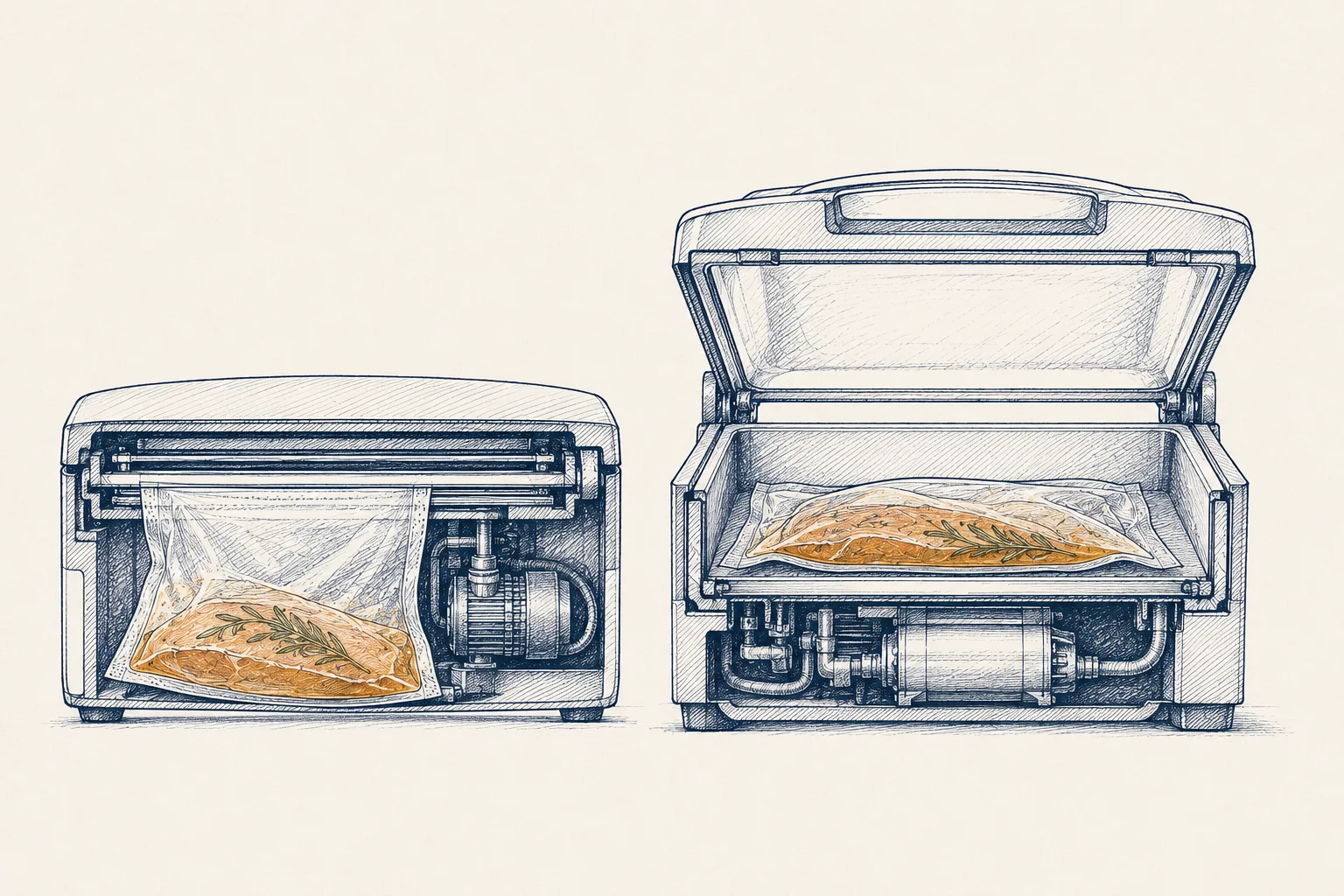
An external sealer pulls air out through the open mouth of the bag. Anything liquid sits in the air path, and the machine will siphon it toward the pump and the seal zone. Industry documentation is blunt about it: edge sealers "can not vacuum seal liquids with certainty due to siphoning effect" (E·01). A chamber machine works on a different principle. The whole pouch sits inside a chamber, air leaves the chamber and the bag at the same time, and pressure stays equal on both sides, so "the food or liquid being sealed stays wherever you have placed it" (E·02). Sealing a bag of soup in a chamber machine is a normal cycle, not a trick.
Not every liquid job is the same job, either: a rinsed fillet, a marinated cut and a quart of soup put different demands on a sealer, and our guide to sealing wet foods and marinades breaks those tiers apart machine by machine. There is a workaround on external machines, and it is worth knowing before you spend chamber money. Pre-freeze. Stand the bag upright in the freezer "for 1-3 hours" until liquids and fats are solid enough that the machine can't pull them in, then seal (E·03). It works. It also adds hours of lead time to every wet bag, ties up freezer space, and for sous vide it means adjusting the cook because the food starts semi-frozen (E·03).
So the real question is how often you are willing to plan three hours ahead. If liquids are a weekly event in your kitchen, chamber wins outright. Meal preppers freezing soups, sous vide cooks bagging meat with marinade, anyone packing stews. If liquids come up a few times a year, the workaround is fine and this question drops out of your decision.
How many bags will you use in two years?
Cheap pouches are the most quoted argument for chamber machines, so they deserve a real model instead of a magic number.
The bags differ for a physical reason. An external sealer can't pull air through a smooth bag, since "the machine can't remove air if the bag doesn't have one textured side" (E·04). That embossed texture is an extra manufacturing step, and you pay for it on every bag. Chamber pouches are plain smooth poly and nylon, and in bulk they cost very little. If you already own an external sealer, generic embossed bags do the same channel job for less; our generic-bag compatibility guide works through fit, seal reliability and the price math for that route specifically. Mylar is a different bag-material question again, built for an oxygen barrier rather than a vacuum channel, and our guide to sealing mylar bags with a FoodSaver covers where that long-term-storage compatibility holds and where it doesn't.
Here are the prices we pulled from the listings and price surveys. Substitute your own when you run the numbers.
| Consumable | Documented price per bag | Evidence |
|---|---|---|
| Generic embossed bag (quart or gallon class) | $0.12 to $0.28, model uses $0.20 | (E·05) |
| Name-brand embossed (FoodSaver class) | model uses $0.40 | (E·05) |
| Generic chamber pouch (bulk, about 1,000 count) | $0.04 to $0.10, model uses $0.07 | (E·05) |
| Brand chamber pouch (Anova, 100 pack at $29) | $0.29 | (E·06) |
For the machines: a compact dry-pump chamber is documented at $374 (E·12) and an entry commercial chamber at about $949 (E·10). We assume a $150-class external as the baseline. Adjust to whatever you would actually buy.
Break-even bags equal the machine price difference divided by the per-bag savings. That's the whole model.
Scenario A uses generic bags on both sides, which saves $0.13 a bag:
| Usage | Bags per week | Bags in 2 years | 2-year bag savings | Break-even, $374 chamber | Break-even, $949 chamber |
|---|---|---|---|---|---|
| Light | 3 | ~312 | ~$41 | ~1,720 bags, about 11 years | ~6,150 bags, about 39 years |
| Moderate | 10 | ~1,040 | ~$135 | about 3.3 years | about 12 years |
| Heavy | 30 | ~3,120 | ~$406 | about 13 months | about 4 years |
Scenario B assumes you were buying name-brand embossed bags at $0.40, which saves $0.33 a bag. Break-even on the $374 chamber falls to about 680 bags. That is roughly 16 months for a moderate user and 5 to 6 months for a heavy one. The $949 machine breaks even around 2,400 bags, about a year and a half of heavy use.
Scenario C is the case the marketing comparisons skip (E·06, E·05). If you buy brand chamber pouches at $0.29 while generic embossed bags cost $0.20, the chamber machine's consumables cost more per bag, and the bag math never breaks even.
These break-even figures are our calculation from the sourced prices, not a number any single source states (E·07). Plug in the bags you actually buy and check it yourself: the model above uses prices documented at the time of research, bulk pouch pricing moves, and while the structure of the math holds, the inputs need refreshing before you trust the output.
Where does that leave you? Bag economics alone justify a chamber machine for moderate to heavy users willing to buy generic bulk pouches. Hunters, bulk buyers, meal-prep households running ten or more bags a week. Payback also speeds up a lot for anyone currently paying brand-name embossed prices. Light users should treat cheap pouches as a bonus, not the reason to buy.
For a single documented example in this class, our review of the Avid Armor USV32 walks this same bag math against one specific $529 machine (75/100, medium confidence). Our comparison of that machine against its smaller sibling, the USV20, covers where the extra chamber size actually earns its keep. Once you have settled on a chamber, our guide to the best chamber vacuum sealer for home use sorts the models with a public record by cabinet gap, pouch size and pump upkeep.
How much do you seal per session?
Batch size is a duty-cycle problem, and it has three tiers, not two.
Documented guidance for domestic external sealers says "most domestic units can operate for 20-30 seconds, then require a 20-second rest before the next seal," with pauses recommended every five or six bags and a 30 to 45 minute lockout if the thermal protection trips (E·08). Moist food makes it worse because the pump runs longer per bag (E·08). If your sessions look like forty packages after a deer, or the whole garden in one weekend, a $100-class suction machine is working at the edge of its design.
The alternative here isn't necessarily a chamber machine. Prosumer externals exist for exactly this job. The Weston Pro-2300 pairs a fan-cooled double-piston pump rated at 28 inHg with a 15 inch seal bar, weighs about 22 pounds, and is built for sustained repetitive sealing (E·09). If you seal a lot per session but it is all dry or solid, that middle tier costs less than commercial chamber gear and weighs a quarter as much.
Chamber machines solve session volume differently. The VP215's oil-lubricated rotary pump is made for continuous commercial operation, with cycles of roughly 30 to 40 seconds each (E·11, E·10). Notice the cycle time. A chamber machine is not faster per bag than a suction machine. It just keeps going, and your hands are free while it runs. Even a spec this basic isn't settled everywhere: retail listings state a 1/5 HP pump for the VP215 while an independent review says 1/4 HP, and the manufacturer's own site blocked our retrieval, so we could not resolve which figure is current (E·10).
Count your worst realistic session. Under ten bags in a sitting, any machine copes. Dozens of dry bags, get the fan-cooled prosumer external. Dozens of bags including wet food, get the chamber.
Will your kitchen absorb the machine?
Chamber machines cost counter space, and the commercial class costs serious weight. The compact tier has closed most of the gap.
| Attribute | Typical external | Compact chamber | Commercial chamber |
|---|---|---|---|
| Footprint | Long and low; stores in a cabinet | 13.6 x 11.2 x 8.9 in (E·12) | 14 x 20 x 15 in (E·10) |
| Weight | A few pounds domestic, about 22 lb prosumer (E·09) | Not published by the manufacturer (E·12) | 84 lb (E·10) |
| Bag or pouch size limit | Any bag narrower than the seal bar, up to 15 in on the Pro-2300 (E·09) | Pouch must fit inside the chamber | 10 x 13 in max bag (E·10) |
| Price class | Under about $200 domestic; prosumer higher | $374 documented (E·12) | About $949 documented (E·10) |
An 84 pound machine (E·10) is not something you slide out of a cabinet on Sunday. It claims a permanent stretch of counter or its own cart. The compact chamber tier is a different proposition, roughly the footprint of a bread maker (E·12), and it is the reason "chamber means commercial kitchen" is outdated advice.
Capacity runs the other way. An external sealer can seal a bag as long as you like, as long as it fits the bar width. A chamber machine can never seal anything bigger than its chamber (E·10, E·12). Whole briskets, long fish and oversized rolls belong to externals, whatever your budget.
What maintenance are you signing up for?
External machines fail at the gasket, the seal strip, and anywhere moisture reaches. Documented failure modes cluster exactly where the liquids question predicted: "wet foods are one of the biggest reasons bags fail to seal properly because liquid can move into the seal area," worn gaskets and compressed seal pads cause weak vacuum and re-inflating bags, and the heat strip overheats during batch work (E·13). That documentation comes from a suction-sealer manufacturer describing its own category, which is why we give it weight.
On the chamber side the maintenance is different in kind, not absent. The VP215's oil pump needs an oil change roughly every 60 hours of running time, checked through a sight window (E·11). A small, scheduled chore, the kind you do on a tractor. Predictable, but real, and it assumes an owner willing to do it. Compact dry-pump chambers advertise no-maintenance pumps (E·12). That claim comes from the manufacturer, and unlike oil pumps it doesn't have decades of commercial history behind it.
One failure mode belongs to chambers alone. The vacuum can be too strong. A VP215 owner reports it is "sometimes too good as it can crush some foods" (E·14). Soft fruit and baked goods need reduced vacuum time or settings.
If your usage is exactly the kind that kills suction machines, wet food and long batches, then gasket and seal-strip life becomes your real cost of ownership. If you buy an oil-pump chamber instead, decide now whether you will actually do the oil changes. Longevity claims for either category, chamber machines lasting 10 to 30 years against suction machines lasting a month to a decade, come mainly from dealer material selling both (E·01); most enthusiast forum threads we tried to open on the subject blocked automated retrieval, so treat any such claim, in either direction, as low confidence.
Is either upgrade actually necessary?
For plain sous vide, maybe not. That is worth hearing before you spend $400 to $950.
In user discussions, experienced sous vide cooks point out that "even a Foodsaver vacuum packer is more than you need for most Sous Vide cooking," and that water displacement with zipper bags covers many cooks entirely (E·14). The vacuum-depth numbers in marketing, around 80% air removal for suction against up to 99.8% for oil-pump chambers (E·01), matter for long freezer storage and for infusions and compression; both figures are the vendors' own, and no source we found instruments final vacuum independently across machine classes to check them. Sous vide itself only needs the bag to sink; our guide to vacuum sealers for sous vide covers bag heat ratings and which machine fits which cook.
If a basic suction sealer is genuinely all you need, our review of the Anova Precision Vacuum Sealer Pro covers what a good one actually does with moist food and marinades (75/100, medium confidence). Two comparisons dig into that same tier: the Nesco Deluxe VS-12 against the FoodSaver V4840, and the Anova Sealer Pro against that same FoodSaver.
Name the benefit you are actually buying: liquid handling, bag economics, session endurance, or deep vacuum for storage. If none of the four applies, the answer may be to keep the machine you have.
Bottom line
Buy it if
- Chamber: weekly liquids (soups, marinades, sous vide with sauce). That alone decides it
- Chamber: ten or more bags a week with generic bulk pouches. The math pays back in one to three years
- Prosumer external: big dry-food batch sessions without chamber money or an 84 lb machine
- Domestic external: a few dry or solid bags a week in a small kitchen
Skip it if
- Chamber: light users buying it for the cheap bags. Break-even can exceed a decade
- Chamber, commercial class: anyone unwilling to give up permanent counter space or change pump oil
- External: anyone routinely sealing free liquids without three hours of pre-freeze lead time
- Either upgrade: plain sous vide cooks already served by displacement or a working suction machine
Liquids and volume buy chambers. Space and low volume keep externals. The bag-cost argument is only true after you check it against your own bag count. This guide is a synthesis of documentation, independent reviews and user reports, weighted by source type; none of it is our own bench testing, which is why the label on this page reads medium confidence rather than high.
The evidence
Every E·NN marker in the article is a link into this ledger: the claim, the exact words of the source, where it comes from, and how sure we are. Each entry links back to the section that cites it.
External (edge/suction) sealers cannot reliably seal free liquids because of siphoning, and pull less air than chamber machines (dealer figures: ~80% vs ~90% dry-piston chamber and up to ~99.8% oil-pump chamber).
'Can not vacuum seal liquids with certainty due to siphoning effect'; 'Only 80% of air is pulled using edge vacuum sealers' (comparison section).
Counter-evidence considered
Percentages are a dealer's numbers, not independent lab measurements; no independent instrumented comparison found after searching for third-party vacuum-level tests.
In a chamber sealer, pressure inside and outside the pouch is equalized during the cycle, so liquids stay in place and can be sealed directly.
'Equalized pressure within the chamber ensures that the food or liquid being sealed stays wherever you have placed it.' (features section)
Counter-evidence considered
None found after searching suction-sealer maker sites; even suction-machine vendors (Avid Armor, JVR) concede chamber machines handle liquids.
↩ First cited in “Do you seal free liquids more than occasionally?”
The standard workaround for sealing liquids on an external sealer is pre-freezing the bag upright for roughly 1–3 hours until liquids/fats are solid enough not to be sucked into the machine.
'put it upright in the freezer for 1-3 hours (depending) before you seal it' (article body).
Counter-evidence considered
None found after searching FoodSaver support/manual excerpts and forum guides; sources differ only on details (moist mode, pulse control), not on the need for a workaround.
↩ First cited in “Do you seal free liquids more than occasionally?”
External sealers physically require textured/embossed bags, a smooth bag gives the machine no air channel, while chamber machines use smooth flat pouches.
'the machine can't remove air if the bag doesn't have one textured side' (bag types explainer).
Counter-evidence considered
None found after searching manufacturer bag pages; Anova's pouch page states the same from the chamber side (no 'internal mesh grooves' needed).
Documented consumable prices: generic embossed bags run about $0.12–$0.28 per quart/gallon-class bag (name-brand embossed can exceed twice generic prices); generic chamber pouches run about $0.04–$0.10 per bag in bulk.
Price tables: quart textured bags '$0.12'–'$0.28'; chamber bags '$0.04 to $0.10' in 1,000-bag quantities; FoodSaver 'more than twice as expensive.'
Counter-evidence considered
Anova's own chamber pouches cost ~$0.29 each, brand-name chamber pouches can cost MORE than generic embossed bags, so 'chamber bags are always cheaper' is false at brand pricing.
Anova's brand chamber pouches sell at $29.00 per 100-pack (~$0.29 per pouch), 11.0 x 9.8 in.
100 pouches, 'Regular price: $29.00'; size '280mm x 250mm | 11.0 x 9.8 inches' (product page).
Counter-evidence considered
Generic chamber pouches are far cheaper ($0.04–$0.10 in bulk per The Rational Kitchen), so this price is a brand premium, not the category floor.
At documented bag prices, bag savings alone repay a compact chamber machine's price premium only after roughly 700–1,700 bags; below ~10 bags a week, payback typically exceeds two years unless you were buying name-brand embossed bags.inference
Derived from the source's per-bag price tables ($0.12–$0.28 embossed vs $0.04–$0.10 chamber) combined with documented machine prices; calculation shown in article.
Counter-evidence considered
Sensitive to assumptions: brand embossed bags ($0.40+) or heavy usage flip the conclusion; brand chamber pouches (~$0.29) can make chamber consumables more expensive, never breaking even.
Most domestic external sealers have a limited duty cycle, roughly 20–30 seconds of operation followed by a ~20-second rest, and need cooling breaks during batch sessions, with thermal shutdown lockouts of 30–45 minutes if overheated.
'Most domestic units can operate for 20-30 seconds, then require a 20-second rest'; 'Allow at least 30-45 minutes of cooling time after thermal shutdown.'
Counter-evidence considered
Not universal: prosumer externals with fan-cooled pumps (e.g., Weston Pro-2300) are documented as designed for sustained repetitive sealing.
The Weston Pro-2300, a prosumer external sealer, uses a fan-cooled double-piston pump rated at 28 inHg, weighs about 22 lb, and is positioned for extended, repetitive batch sealing.
'28Hg of vacuum pressure'; 'a fan-cooled motor' that 'prevents overheating during extended use'; weight 22 pounds (specs section).
Counter-evidence considered
Forum users report even higher-priced externals eventually failing, but we could not fetch and verify those threads directly; treat longevity as unproven.
The VacMaster VP215, an entry commercial chamber machine, weighs 84 lb, measures 14 x 20 x 15 in, uses a heavy-duty 1/5 HP oil pump, takes bags up to 10 x 13 in, and lists around $949.
Specs: '84 lbs.', '14 x 20 x 15 in', 'Heavy-Duty 1/5 HP Oil Pump', price $949.00 (product page).
Counter-evidence considered
Sizzle and Sear's review states '1/4 HP' for the same pump, a genuine spec discrepancy between sources; we could not fetch VacMaster's own page (blocked) to adjudicate.
The VP215's oil pump needs an oil change roughly every 60 hours of use (with a sight window for checking), and a full vacuum-seal cycle takes about 30–40 seconds.
'only need to change the oil after 60 hours of use'; takes '30-40 seconds to vacuum and seal' (review body).
Counter-evidence considered
None found after searching VP215 owner discussions; VacMaster's own manual could not be fetched to confirm the interval wording.
The Anova Precision Chamber Vacuum Sealer measures 13.6 x 11.2 x 8.9 in, uses a 70 L/min no-maintenance dry pump, has an 11.8 in seal bar, and lists at $374.
'345W x 285D x 225H mm | 13.6 x 11.2 x 8.9 in'; '70L/min 12VDC No maintenance dry pump'; price $374.00 (spec section).
Counter-evidence considered
Weight is not published on the product page; no independent verification of the '70 L/min' figure found.
Documented failure modes of external sealers cluster around moisture and wear: liquid or residue at the seal edge interrupting heat transfer, worn gaskets/compressed seal pads losing vacuum, and overheated heat strips during batch work.
'wet foods are one of the biggest reasons bags fail to seal properly'; 'Worn gaskets or a compressed seal pad'; heat strip 'can get too hot' in batches.
Counter-evidence considered
This is a suction-sealer maker describing its own category's failures (against interest); no source found disputing these modes.
Users report that a strong chamber vacuum can crush delicate foods, and that for basic sous vide a FoodSaver-class machine (or even bag displacement) is often sufficient.
VP-215 owner: 'sometimes too good as it can crush some foods'; another user: 'even a Foodsaver vacuum packer is more than you need for most Sous Vide cooking.'
Counter-evidence considered
Single-thread anecdotes; most chamber machines offer adjustable vacuum time/level, which mitigates crushing (per manufacturer preset descriptions).
Built from the documented record: specifications, manuals, published measurements and owner reports, each itemized in the evidence ledger above. How we work
Sources
- 01Anova Precision Chamber Vacuum Sealer · official product page
- 02Anova Precision Chamber Vacuum Sealer Pouches · official product page
- 03Avid Armor · Suction Vacuum Sealers vs. Chamber Vacuum Sealers
- 04Avid Armor · Why Your Vacuum Sealer Won't Seal: 7 Causes + Fixes
- 05VacMaster VP215 Chamber Vacuum Sealer · retailer listing with full specs
- 06JVR Industries · Suction Vacuum Sealer vs Chamber Vacuum Sealer
- 07JVR Industries · 3 Differences: Chamber Pouches & FoodSaver Bags
- 08Sizzle and Sear · VacMaster VP215 Review
- 09The Rational Kitchen · The Best Food Vacuum Sealer Bags (For the Best Prices)
- 10Foodal · Weston Pro-2300 Vacuum Sealer Review
- 11Pac Food · How to Prevent Your Vacuum Sealer from Overheating
- 12Amazing Food Made Easy · Easily Seal Liquids with a FoodSaver Vacuum
- 13Anova Community Forum · Chamber Vacuum Sealer (user thread)