Vacuum sealing · Guide
Research-basedBest vacuum sealer for wet foods and marinades
Moist food, marinated solids and free liquid put three different demands on a sealer. A tier-by-tier breakdown of what each documented machine actually does with each one.
Illustration
Contents
The short answer
Three separate problems, not one. Plain moist food, a rinsed fillet, a marinated chicken breast, is fine on a good suction sealer with a wet mode: the Anova Sealer Pro or the FoodSaver V4840. A cut resting in a defined pool of marinade favors a chamber machine's marinate function, Avid Armor's USV20 and USV32 both have one, though the Sealer Pro can do it with pulse-and-seal technique and a basin you'll clean out. Free liquid, soup, stock, a marinade with nothing solid in it, only seals directly on a chamber sealer: USV32, USV20 or VP215. Every suction machine needs the freeze-first workaround instead, and that workaround is the same one no matter which suction sealer you bought.
Wet food is three different problems, and most buying guides answer as if it were one. A fillet that's merely damp from a rinse is nothing like a steak resting in a cup of marinade, and neither is anything like a quart of stock with no solid food in it at all. Call them three tiers: moist food, marinated solids, free liquid. Each one asks a sealer to do something different, and the machines in this guide answer differently at each tier: the tier a machine wins says nothing about the next one.
The trouble shows up the moment you press the button. Bag chicken thighs that have been sitting in soy, ginger and garlic since morning, and marinade beads up at the seal edge instead of disappearing quietly into the pump. Try the same thing with a container of leftover chili and it goes worse: the pump strains, liquid climbs the tube, and the cycle stops itself before the bag ever closes. We pulled documented specs and manuals from Anova, Avid Armor, VacMaster, Weston and FoodSaver, plus independent tests and owner reports, and every factual line below carries a marker like (E·01) pointing at the evidence ledger.
Why the tiers exist
External sealers pull air out through the open mouth of the bag. Anything liquid sits in that same path, and a pressure imbalance forms between the inside of the bag and the outside world, which pulls loose liquid toward the pump. Industry documentation calls it a siphoning effect and puts suction machines at pulling only about 80 percent of the air out of a bag, against roughly 90 percent for a dry-piston chamber and up to 99.8 percent for an oil-pump chamber (E·01). A chamber machine skips the problem by design. The whole pouch sits inside a sealed chamber, air leaves the bag and the space around it at the same time, and pressure stays equal everywhere, so liquid has nowhere to be pulled toward (E·02).
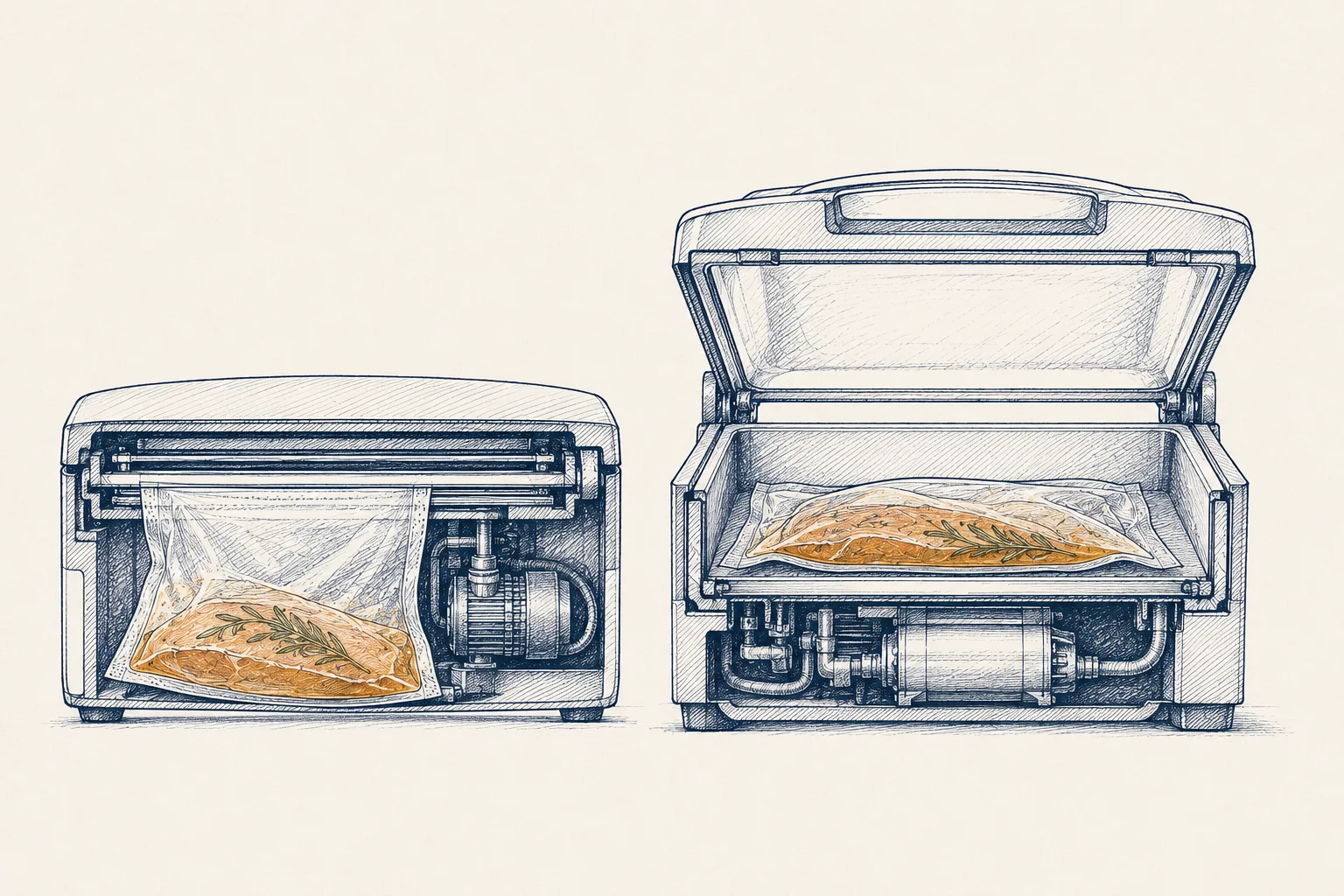
That single mechanism is the whole reason the three tiers behave so differently machine to machine, and it's the subject of our chamber-vs-external pillar if you want the fuller decision, bag costs, duty cycle, counter space, all of it. Here we stay narrow: which machine handles which kind of wet food, and how well.
Tier one: moist food
This is the easy tier, and most machines built in the last few years handle it. Think a rinsed fish fillet, a chicken breast that picked up some marinade in transit, leftovers with sauce clinging to them, nothing you'd pour.
Anova built the Sealer Pro's whole pitch around this tier. The product page promises it handles "even the juiciest of foods, no problem" through a low pressure suction function and a double sealer, and calls out the moist vs dry settings as ideal for anything carrying moisture (E·03). America's Test Kitchen backs that up with actual testing: the Sealer Pro "reliably kept all sorts of dry and wet foods perfectly sealed over time," and its dedicated wet mode sealed foods with liquid especially well, alongside a measured vacuum strength of 76.87 percent (E·04). That's a real result, not just marketing. For what a good moist-mode suction sealer looks like in practice, our Sealer Pro review covers the rest of the machine.
It isn't effortless on any suction sealer, though. Domestic units are rated to run 20 to 30 seconds before a 20-second rest, and moist food extends that vacuum time significantly because the pump has to work harder against liquid in the path (E·05). Batch-seal a dozen marinated cuts back to back and you'll feel that limit before you feel it on dry bags.
Weston splits this tier in half. The Pro-2300's manual is fine with ordinary moist food, but it specifically tells owners to freeze very moist items like fish before sealing, and it warns hard against letting liquid reach the vacuum port at all, telling users to hit Manual Seal early rather than risk it (E·06). Ordinary moisture: no problem. Genuinely dripping fish: freeze it first, the same rule that governs the free-liquid tier below.
FoodSaver's V4840 has the automatic moisture detection and a moist/dry toggle you'd expect, but the owner record is mixed. An aggregator covering roughly 17,610 reviews reports 91 percent positive sentiment overall, and also a recurring complaint that liquid gets pulled too fast and is hard to control during the cycle (E·07). It works. It just asks more attention than the Sealer Pro's wet mode seems to.
The chamber machines in this guide, the USV32, the USV20 and the VP215, don't really have a tier-one story worth telling separately: moist food is trivial for a mechanism that equalizes pressure around the whole pouch. Their real test starts at tier two.
Tier two: marinated solids
Now the food is mostly solid, but it's sitting in a visible pool: a steak in a cup of teriyaki, chicken thighs you want infused fast instead of soaked overnight.
Avid Armor built an actual feature for this tier. Both the USV20 and the USV32 run a marinate function, defined by the company's help center as a period of vacuum for a 60 second cycle without a seal, meant to pull marinade into the food and speed up what would otherwise take hours (E·10). The USV20's own page frames it directly: "the marinate function drives liquid into meat under vacuum instead of waiting overnight for it to soak in," and separately claims that soups, sauces, brines and marinades "seal airtight because the liquid is never pulled toward a suction port" (E·09). The USV32 carries the same stainless chamber, 11.5 x 12 x 3.5 in, marketed for exactly this kind of wet food, brine and marinade work (E·08). Our USV32 review covers the rest of what that machine documents.
The Sealer Pro can do marinated solids too, just with more technique and less margin. In an Anova owner forum thread asking whether the machine really seals liquids, experienced owners describe pulse-vacuuming and pressing Seal the moment liquid nears the port, and note the drip basin needs cleaning after every significant wet run (E·11). The thread is also a useful lesson in how these anecdotes inflate: its cleanest success story, sealing two chicken legs in about a cup of marinade, got retracted days later when the poster realized he actually owned Anova's chamber sealer, not the Sealer Pro (E·11). Technique works. It also isn't as bulletproof as the win stories first suggest.
FoodSaver takes a third path entirely: a separate Quick Marinator canister, connected by hose and adapter rather than sealed inside the bag itself. Press the marinate button and it pulls a vacuum that forces liquid into the food, with usable flavor absorption in as little as thirty minutes (E·12). It works well for what it is, but it's an extra accessory and an extra container, not something the sealing bag itself does.
Tier three: free liquid
Soup. Stock. A marinade with no solid food in it at all. This is where the category actually splits.
A suction-sealer maker's own troubleshooting documentation names wet food as one of the biggest reasons bags fail to seal, because liquid moves into the seal area, and recommends chamber machines as the more reliable option for anyone who handles liquid regularly (E·16), advice coming from a company that also sells the machines it's warning you about. Anova's own quick start guide for the Sealer Pro backs the caution up from the inside: a crossed-out-bag icon telling users to avoid liquids in the bag, and a troubleshooting table that lists liquid at the bag edge as the first cause of a failed seal (E·17). The workaround, on the Sealer Pro, the FoodSaver V4840, and the Weston Pro-2300 alike, is the same one: stand the bag upright in the freezer for 1 to 3 hours until the liquid and any fat firm up enough not to get pulled in, after cleaning the bag's neck first so nothing freezes onto the sealing edge (E·13). It works. It also means planning three hours ahead every time you want to freeze a bag of soup.
Chamber machines just seal it. A reviewer who ran the USV32 for three months reports sealing homemade soup "without any mess," with the stainless chamber holding up well under that kind of repeated wet use (E·15). An independent review of the VP215 goes further, calling it able to seal liquids and liquid-rich foods, fresh meats, soups, marinades, stews, better than most suction sealers, specifically because the chamber vacuums everything at once instead of pulling air, and liquid with it, out through the bag mouth (E·14). If you're weighing the USV32 against the VP215 for this kind of work, our USV32 vs VP215 comparison covers the rest of the trade-off: size, weight, oil maintenance, price. The USV20 shares the same free-liquid claim as its bigger sibling (E·09), just in a smaller chamber.
Why none of this is a head-to-head
None of this is an instrumented head-to-head. No source in this guide ran a controlled test pouring the same cup of soup into every machine and scoring the result; every liquid-handling claim here comes from a manufacturer's own framing, a single reviewer's kitchen, or a self-selected forum. The Anova thread's retracted marinade story (E·11) is a real reminder that even sincere owner reports can describe the wrong machine.
Chamber machines carry their own caveat that has nothing to do with liquid: a strong vacuum can be too good. One VP215 owner reports it "sometimes too good as it can crush some foods," and a different thread notes that a basic suction sealer, or even bag displacement, is more than most sous vide cooking actually needs in the first place (E·18); our guide to vacuum sealers for sous vide sorts which cooks need a machine at all. Deep vacuum solves a liquid problem. It can also flatten a soft one.
Bottom line
Buy it if
- Tier one, moist food: a suction sealer with a real wet mode, Anova Sealer Pro or FoodSaver V4840, no special handling needed
- Tier two, marinated solids: Avid Armor's marinate function (USV20 or USV32) for hands-off infusion, or a suction sealer with pulse-and-seal technique
- Tier three, free liquid: a chamber sealer, USV32, USV20 or VP215, sealed directly with no prep
- Any tier on a suction sealer if you don't mind the freeze-first workaround and its three-hour lead time
Skip it if
- Free liquid on any suction sealer without pre-freezing; the manuals and the manufacturers' own troubleshooting agree it fails
- Marinated solids on a suction sealer if you want zero technique and zero basin cleaning
- Delicate or soft foods on a chamber sealer at full vacuum without checking for a gentler setting first
- Buying based on one machine's win at one tier; the tier that matters is the one you actually cook
Name your actual tier before you shop. Moist food is a solved problem on several machines. Marinated solids reward a dedicated marinate function or real technique. Free liquid, soup and stock with nothing solid in it, still belongs to chamber machines alone, and every suction sealer answers it the same way: freeze it first.
The evidence
Every E·NN marker in the article is a link into this ledger: the claim, the exact words of the source, where it comes from, and how sure we are. Each entry links back to the section that cites it.
External (suction) vacuum sealers create a pressure imbalance between the outside and inside of the bag that produces a siphoning effect on any liquid content, and documented air-removal figures put edge sealers at pulling only about 80 percent of air against roughly 90 percent for dry-piston chamber machines and up to 99.8 percent for oil-pump chamber machines.
'a pressure imbalance is produced between the outside and inside of the bag. This can cause a siphoning effect when sealing foods containing liquids'; 'Only 80% of air is pulled using edge vacuum sealers'; 'Dry piston chamber vacuum sealers can remove around 90% of air which is still a stretch from reaching the astounding minimum of 99% drawn using a chamber vacuum sealer geared with an oil pump!'; oil-pump chamber sealers remove 'up to 99.8%' of air.
Counter-evidence considered
These are a chamber-machine dealer's own figures, not an independent instrumented comparison. We searched for a third-party lab measurement of air-removal percentage across machine classes and found none.
A chamber vacuum sealer evacuates air from the whole chamber, not just the bag, so pressure equalizes on both sides of the pouch wall and liquid never gets pulled toward a pump. Anova states this plainly for its own compact chamber machine.
'Equalized pressure within the chamber ensures that the food or liquid being sealed stays wherever you have placed it within the sealer pouch.'
Counter-evidence considered
This is the mechanism's own maker describing its own machine, but the physics is uncontested across the category. Every suction-sealer document we opened for this guide concedes the same limitation from the other side (E·01, E·16).
Anova's product page promises the Sealer Pro handles even the juiciest of foods with its low pressure suction function and double sealer, and highlights the moist vs dry settings as ideal for foods carrying moisture.
'built with a low pressure suction function and a reliable double sealer to handle even the juiciest of foods, no problem'; 'the moist vs dry settings, which are perfect for sealing foods with moisture content.'
Counter-evidence considered
This is marketing copy scoped to moist food, food carrying liquid rather than a bag of free liquid. The same product's manual separately warns against liquid pooled loose in the bag (E·17).
America's Test Kitchen's verdict on the Sealer Pro reports it reliably kept dry and wet foods sealed over time and that its dedicated wet mode sealed foods carrying liquid especially well, alongside a measured vacuum strength of 76.87 percent and a $136.00 price.
'reliably kept all sorts of dry and wet foods perfectly sealed over time'; wet mode 'let us seal foods with liquid especially well'; 'Vacuum Strength: 76.87%.'
Counter-evidence considered
ATK sells the product on the same page that carries this verdict, a real conflict of interest even though its testing program is editorially separate. 'Foods with liquid' describes food carrying moisture, not a bag of free liquid.
Most domestic external sealers are rated to run 20 to 30 seconds before a 20-second rest, and moist food makes that worse because a wet load extends the vacuum time significantly, since the pump has to work harder to remove air with liquid in the path.
'Most domestic units can operate for 20-30 seconds, then require a 20-second rest before the next seal'; 'Moist foods extend vacuum time significantly because the machine has to work harder to remove air.'
Counter-evidence considered
This is guidance from a dealer that also sells chamber machines, but it matches the failure mode a suction-sealer manufacturer documents about its own products (E·16).
Weston's manual for the Pro-2300 warns against letting liquid reach the vacuum port, tells the user to press Manual Seal early if liquid is approaching even though that means an incompletely evacuated bag, and specifically advises freezing very moist foods such as fish before vacuum sealing.
'DO NOT allow liquids to be sucked into the Vacuum Port or unit damage may occur'; press 'the Manual Seal Button' before liquids reach the port, accepting the bag 'may not be completely evacuated of air'; 'It is best to freeze very moist food items, like fish, before vacuum sealing.'
Counter-evidence considered
Our attempt to re-open this PDF today returned only encoded stream data, not readable text; the quotes above come from a successful text-mode capture of the same document earlier in this research window, and the URL and document are unchanged.
An aggregator of FoodSaver V4840 owner feedback covering roughly 17,610 reviews reports 91 percent positive sentiment, alongside a recurring complaint that liquid is pulled too fast and is hard to control during sealing.
'liquid is pulled too fast and is hard to control'
Counter-evidence considered
This is an aggregation of customer review sentiment with no published methodology or sample size; we treat the specific percentage as directional. FoodSaver's own product page blocked our retrieval on repeated attempts today, so we could not independently confirm the moist/dry setting's wording from the manufacturer.
The USV32's chamber is stainless steel, 11.5 x 12 x 3.5 in and accepts pouches up to 11 x 13 in; Avid Armor markets that chamber as built for wet food, brines and marinades, priced at $529.00 direct against a $599.00 list.
Specs: chamber '11.5 x 12 x 3.5 in', 'Stainless Steel'; the chamber is described as built for 'wet food, brines, and marinades'; price 'Sale price: $529.00' against a '$599.00' regular price.
Counter-evidence considered
This is the manufacturer's own framing; we re-opened the page today and the figures match our earlier capture. The underlying mechanism, equalized pressure with no siphoning, is corroborated across the category (E·02, E·16).
Avid Armor's USV20 page describes the Ultra Series marinate function as driving liquid into meat under vacuum instead of waiting overnight for it to soak in, and states that soups, sauces, brines, marinades and infusions seal airtight on the chamber because the liquid is never pulled toward a suction port.
'The marinate function drives liquid into meat under vacuum instead of waiting overnight for it to soak in.'; 'Soups, sauces, brines, marinades and infusions seal airtight because the liquid is never pulled toward a suction port, and delicate foods come out whole instead of crushed.'
Counter-evidence considered
This is marketing language on the smaller USV20's own page, but it describes the same equalized-pressure chamber design the USV32 uses (E·08), and the cycle length is documented separately (E·10).
Avid Armor's help center defines the Ultra Series marinate function as a period of vacuum for a 60 second cycle without a seal, and recommends placing the item and marinade in a shallow container or a chamber pouch for the cycle.
'a function in which the vacuum sealer will go under a period of vacuum for a 60 second cycle without a seal.'
Counter-evidence considered
This is the USV20's own FAQ page. An independent review credits both the USV20 and USV32 with the same marinate function, so the 60-second cycle likely applies to both, though we could not open a document specific to the USV32's marinate timing.
In an Anova owner forum thread asking whether the Sealer Pro really seals liquids, experienced owners describe the technique for a marinated cut sitting in a defined pool: the machine fails safe by draining stray liquid to a small catch basin that must be cleaned after every significant wet use, and the thread's most confident success story, sealing two chicken legs in about a cup of marinade, was retracted days later when the poster realized he actually owned Anova's chamber sealer.
'Sealing liquids works fine' but the basin 'must be cleaned out after every significant use'; the retracted story described '2 chicken legs in a fair bit of marinade, perhaps a cup' before the poster corrected himself: 'What i have is the Anova Chamber Vacuum Sealer, not the one you aare looking at.'
Counter-evidence considered
Self-selected reports with no failure base rate. The retraction itself is the useful data point here: the thread's cleanest wet-seal success story turned out to describe the wrong machine entirely, a caution about taking marinade-sealing anecdotes at face value.
FoodSaver's marinate function works through a separate Quick Marinator canister connected by hose and adapter, not through the bag itself: pressing the marinate button pulls a vacuum that forces marinade into the food, with the cycle taking as little as thirty minutes for usable flavor absorption.
'vacuum power to force the marinade mixture into the food'; 'you can marinade the food within thirty minutes.'
Counter-evidence considered
This describes the accessory-container workflow shared across FoodSaver machines with the port, not a V4840-specific test, and it is a different design from a chamber sealer's marinate mode: it needs a separate rigid container, not the bag the food will eventually be sealed in.
The standard workaround for sealing free liquid on an external sealer is standing the bag upright in the freezer for roughly 1 to 3 hours until the liquid and any fat are just solid enough not to be pulled into the machine, after cleaning the bag's neck first so stray liquid doesn't freeze onto the sealing edge.
'put it upright in the freezer for 1-3 hours (depending) before you seal it'; the goal is to 'freeze water-based liquids and/or solidify fats just enough that they won't be sucked into the vacuum packer'; clean 'the neck of the bag... inside and out, BEFORE you put the bag in the freezer.'
Counter-evidence considered
The technique is written around FoodSaver-style machines specifically, but the constraint it addresses, air exiting only through the bag mouth, applies to every external sealer in this guide, the Anova Sealer Pro and the Weston Pro-2300 included.
An independent review states the VP215 can vacuum seal liquids and liquid-rich foods, including fresh meats, soups, marinades and stews, better than most sealers, because the chamber design vacuums the whole chamber at once instead of pulling air, and liquid, out through the bag mouth the way suction machines do.
'can vacuum seal liquids and liquid-rich foods like fresh meats, soups, marinades and stews better than most sealers today'; on suction machines, 'along with air, liquids are also vacuumed out of the bag, leading to partial and even failed seals.'
Counter-evidence considered
One reviewer's assessment on an appliance-review site with no instrumented liquid test. We found no source that publishes a controlled liquid-sealing trial for the VP215.
A reviewer who used the USV32 for three months reports sealing homemade soup without any mess, and describes the stainless construction as holding up well under that kind of wet use.
'I sealed homemade soup without any mess!'; 'stainless steel construction has stood up remarkably well.'
Counter-evidence considered
A single reviewer on an affiliate-monetized site with no instrumented data. We weight it as qualitative corroboration of the chamber mechanism, not a controlled test.
A suction-sealer manufacturer's own troubleshooting guide names wet food as one of the biggest reasons bags fail to seal, because liquid can move into the seal area, and recommends chamber vacuum sealers as the more reliable alternative for anyone who regularly handles liquids and moist items.
'Wet foods are one of the biggest reasons bags fail to seal properly because liquid can move into the seal area.'
Counter-evidence considered
This documentation comes from a company that also sells chamber machines, so it has a reason to steer wet-food buyers toward that category. We give it weight because it is a suction-sealer maker describing its own category's failure mode, against its own short-term interest in that sale.
Anova's own quick start guide for the Sealer Pro carries a crossed-out-bag icon instructing users to avoid putting liquids in the bag, and its troubleshooting table lists liquid at the bag edge as the first cause of a failed seal.
'Avoid using liquids in the bag' beside a crossed-out illustration of a bag holding liquid; troubleshooting for a bad seal begins 'Check if the outside edge of the bag has liquid, oil stain or any chippings?'
Counter-evidence considered
Anova's support pages blocked our automated retrieval again on today's attempt, the same result documented in our Sealer Pro review's research; the quotes come from an earlier successful browser-based capture of the same guide. The warning marks the free-liquid limit specifically, not a ban on moist or marinated food, which the same machine's wet mode handles well (E·04).
Owners on a chamber-sealer forum thread report that a strong chamber vacuum can be too good, crushing soft foods, a limit that has nothing to do with liquid handling; the same thread notes that a basic suction sealer, or even bag displacement, is more than most sous vide cooking actually needs.
VP-215 owner: 'it works great, sometimes too good as it can crush some foods'; another user: 'even a Foodsaver vacuum packer is more than you need for most Sous Vide cooking.'
Counter-evidence considered
Single-thread anecdotes. Most chamber machines, including the ones in this guide, offer adjustable vacuum time or a gentler setting, which mitigates the crushing risk, and the sous vide comment does not address wet food or marinade sealing at all, only whether a deep vacuum is necessary.
Built from the documented record: specifications, manuals, published measurements and owner reports, each itemized in the evidence ledger above. How we work
Sources
- 01JVR Industries · Suction Vacuum Sealer vs Chamber Vacuum Sealer
- 02Anova Precision Chamber Vacuum Sealer · official product page
- 03Anova Precision Vacuum Sealer Pro · product and specifications page, Anova Culinary
- 04America's Test Kitchen shop page · Anova Precision Vacuum Sealer Pro, with ATK review verdict and measured vacuum strength
- 05Pac Food · How to Prevent Your Vacuum Sealer from Overheating
- 06Weston Pro-Series instruction manual PDF
- 07Reviews for FOODSAVER FoodSaver V4840 2-in-1 Vacuum Sealer Machine, aggregated owner feedback · BestViewsReviews
- 08Avid Armor USV32 Chamber Vacuum Sealer · official product page with specifications
- 09Avid Armor USV20 Chamber Vacuum Sealer · official product page with specifications
- 10Avid Armor Help Center · Ultra Series USV20: How To and FAQs
- 11Anova Community forum · Precision Vacuum Sealer Pro, does it really seal liquids?
- 12How To Use FoodSaver Marinade Container? · Miss Vickie
- 13Amazing Food Made Easy · Easily Seal Liquids with a FoodSaver Vacuum
- 14VacMaster VP215 Chamber Vacuum Sealer Review, Pros & Cons · All Great Appliances
- 15Vacuum Sealer Center · Avid Armor USV32 Chamber Vacuum Sealer Review
- 16Avid Armor · Why Your Vacuum Sealer Won't Seal: 7 Causes + Fixes
- 17Anova Precision Vacuum Sealer Pro Quick Start Guide · PDF linked from Anova Support
- 18Anova Community Forum · Chamber Vacuum Sealer (user thread)